 Mon Prof Augmenté
TGV M cutaway: how it works
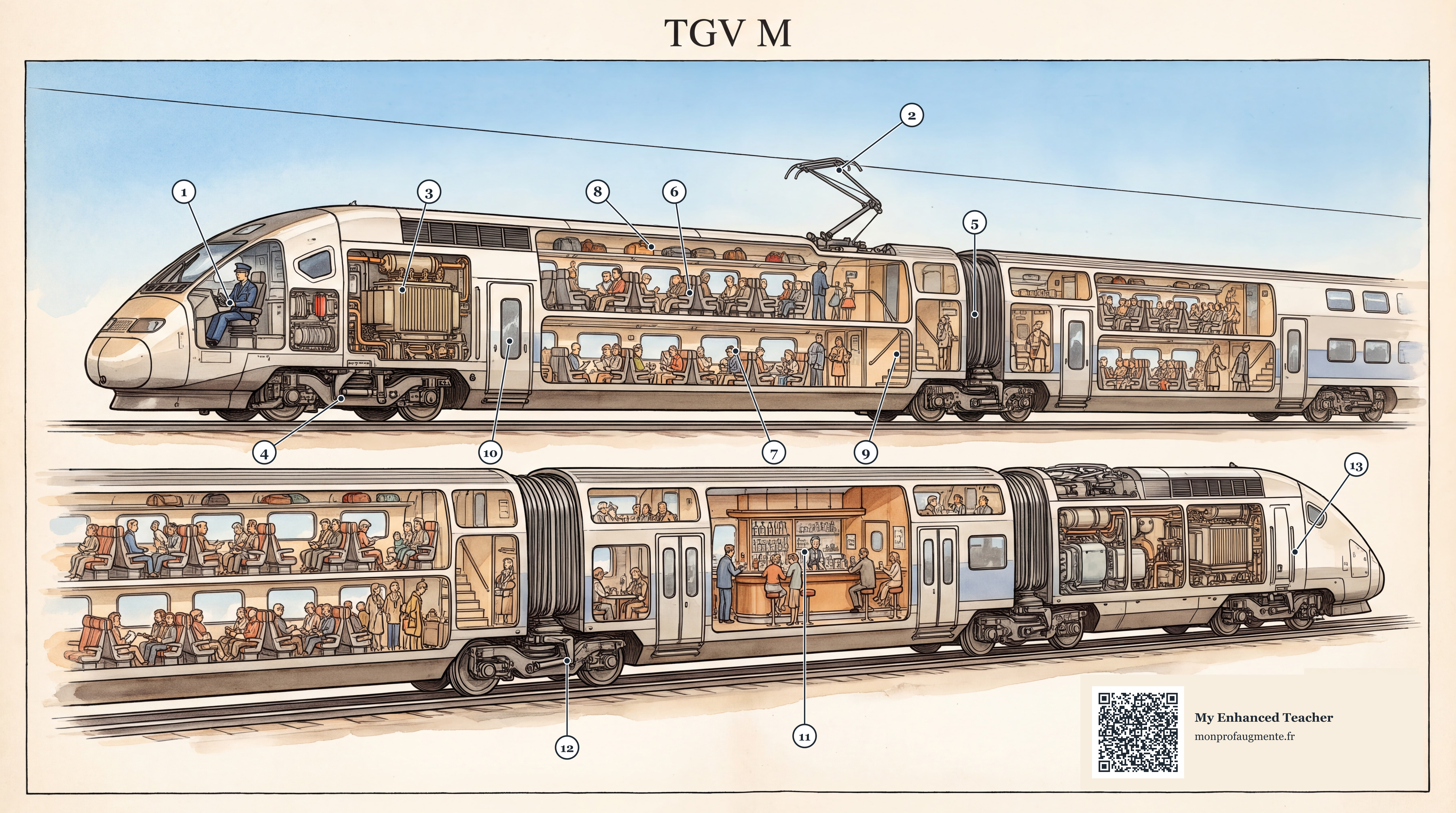
The TGV M is the new high-speed train built by Alstom (Avelia Horizon platform) for the French railway, SNCF. Its inaugural run, from Paris Gare de Lyon to Marseille Saint-Charles, took place on 6 November 2026, and the first passengers board from 9 November. This plate opens the trainset: a short power car at each end, double-deck cars linked together, and a two-level bistro. Each number on the picture is explained in the list below.

See it at full size
On this page the picture is scaled to fit your window. The original is 5504×3072 pixels, about 17 megapixels, so there is much more to see than the page shows at once. Three ways to look closer:
- Press “View at full size”. The viewer opens with the image scaled to your window. Choose Actual pixels to show every pixel of the file, one for one, then drag the picture to move around it. Fit returns to the whole plate. Keys: + and − to zoom, 1 for actual pixels, 0 to fit, Esc to close.
- Open the file itself. Open the full-size image in a new tab. Browsers first show it shrunk to the window. Click the image once to switch to 100 % (Chrome, Edge, Firefox and Safari all do this), then scroll or drag to move around.
- On a phone or tablet, open the full-size image the same way and pinch to zoom. The view is sharp because the file really is that large.
Retina and other high-density screens show an image sharper than its pixel count suggests, so “Actual pixels” shrinks the picture on those screens so that one image pixel really is one screen pixel.
Print it
Do not print from the browser window: it prints the page, not the picture at its full size. Use the downloaded file, which contains all 5504×3072 pixels.
- Download the full-resolution JPEG (3.1 MB).
- Open it in Preview (Mac), Photos (Windows) or any image viewer and choose Print. Do not use the browser’s print preview on this page.
- Set the paper to landscape. Choose Fill page or Scale to fit and keep the proportions. The plate is 16:9, so on A-series paper there will be a white band at the top and bottom, and you should not crop it: the QR code is in the corner.
- Choose the highest print quality, and turn off any “draft” or “save ink” mode.
- For a poster, take the same file to a print shop and ask for the largest size you want. Tell them it is 5504×3072 pixels so they know the sharpness they can expect.
| Paper, long side | Sharpness | Good for |
|---|---|---|
| A4 (297 mm wide) | 471 ppi | Sharp on any printer |
| A3 (420 mm wide) | 333 ppi | Best choice: a wall poster you can read up close |
| A2 (594 mm wide) | 235 ppi | Good from arm’s length |
| A1 (841 mm wide) | 166 ppi | Classroom wall, viewed from a distance |
For a sharp print, aim for 150 ppi or more at the distance you will read it from. Print shops usually want 300 ppi for a close-up look; at A3 this plate reaches 333 ppi.
What each number shows
- Driver’s cab. The driver sits at the front of the power car behind a steeply raked windscreen. Because each end of the trainset has its own power car, the train can set off in the opposite direction without changing locomotive.
- Pantograph. This hinged arm presses against the overhead power line, the catenary, and brings electricity to the train. At high speed it has to stay in contact with the wire despite the shaking, and its shape is designed for that.
- Transformer and electrical equipment. In the power car, the current from the overhead line is transformed and adapted before it feeds the motors. This heavy equipment stays in the power cars, which leaves the other cars for passengers.
- Power bogie. The power car’s wheels are driven by traction motors. The bogie carries the weight of the train and guides it through curves, including at more than 300 km/h.
- Bellows between two cars. A flexible bellows closes the gangway between two cars. Passengers can walk from one car to the next out of the wind, and the trainset forms one continuous tube.
- Upper deck. Each car has two levels, which fits many seats into a trainset of limited length. From the upper deck, the windows give a clear view of the landscape.
- Lower deck. The lower deck is closer to the platform. A staircase leads up to the upper deck from here. Passengers find seats and access to the doors.
- Luggage racks. Above the upper-deck seats, shelves hold hand luggage.
- Staircase. A staircase links the two levels of each car. People who cannot use it have a step-free car, car 3.
- Doors. The doors open at platform level. The TGV M is presented as the first TGV that a wheelchair user can board unaided: car 3 has a built-in lift.
- Two-level bistro. The bistro car has two levels. Downstairs are self-service fridges, coffee machines and microwaves; upstairs are seats (28 according to Wikipedia). The drawing shows a bar counter, which is more traditional than the real service.
- Articulated bogie. On a TGV, two neighbouring cars rest on a shared bogie placed between them. The trainset is shorter, lighter and more stable than with two bogies per car.
- Second power car. At the other end of the trainset, a second power car with its own electrical equipment. These power cars are short to leave room for one more car in the same trainset length.
The TGV M at a glance
| Maker and operator | Alstom (Avelia Horizon platform); SNCF Voyageurs |
|---|---|
| Entry into service | Inaugural run from Paris Gare de Lyon to Marseille Saint-Charles on 6 November 2026, first passengers from 9 November (sources do not all give the same date) |
| Make-up | Two short power cars and 7 to 9 double-deck cars according to Wikipedia; Euronews mentions 8 to 9 cars |
| Length | Up to 202 m with 9 cars (Wikipedia) |
| Speed | 320 km/h in commercial service; 350 km/h design speed according to Wikipedia |
| Energy use | About 20 % less energy than the previous generation (Euronews, Hourrail) |
| Capacity | It depends on the layout: 573 passengers for the first trainsets according to Euronews, up to 700 or 740 at most depending on the source |
| Accessibility | Step-free car 3 with a built-in lift |
Sources: Wikipedia, Avelia Horizon, Euronews (French) and Hourrail (French). The drawing is a simplified illustration: a real trainset has more cars than shown here, and SNCF’s seat plan shows car 3 on a single level. Capacity and make-up figures vary from one source to another.