 Mon Prof Augmenté
Airbus A220 cutaway: how it works
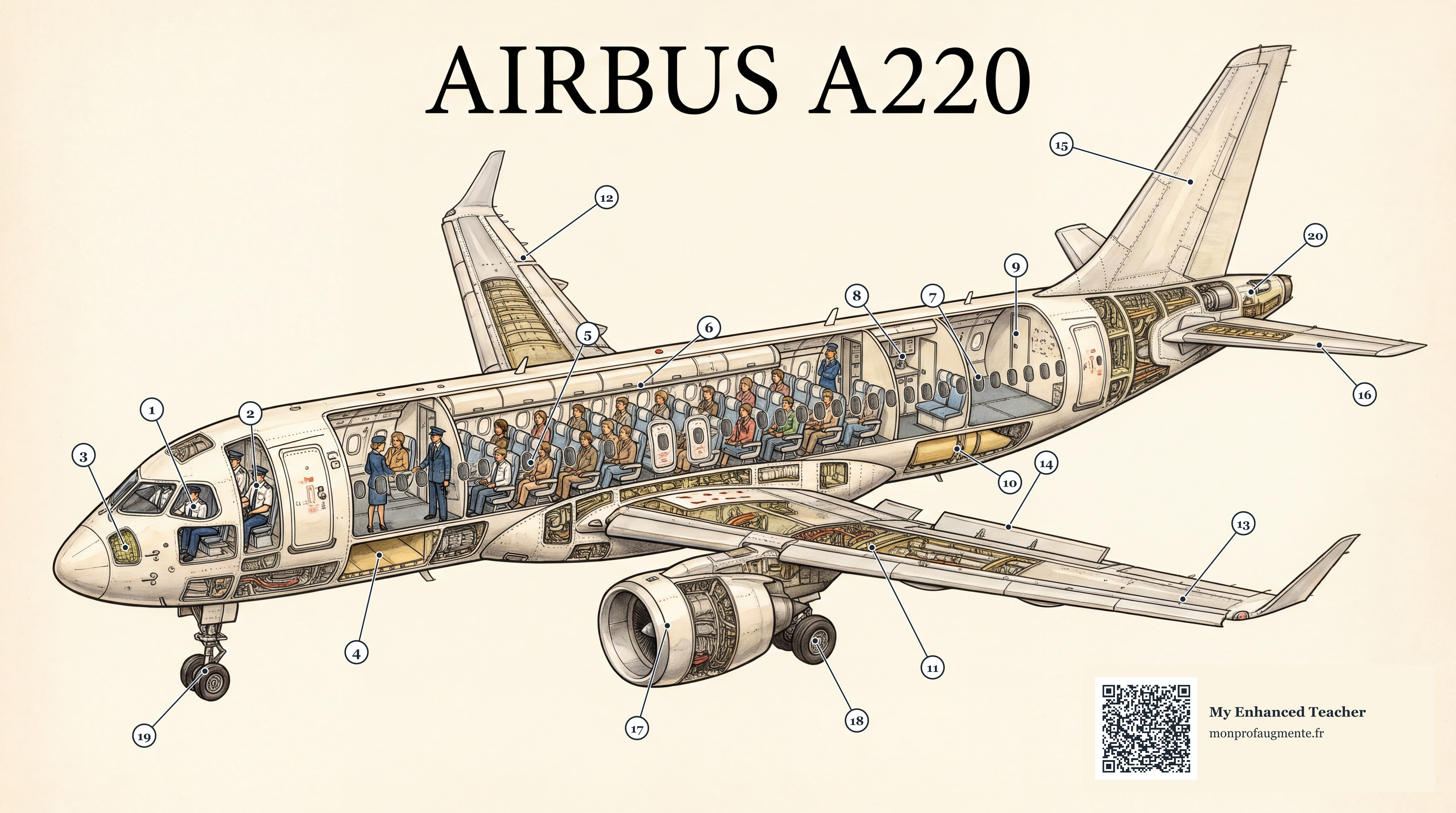
The Airbus A220 is a twin-engine airliner for roughly 100 to 160 passengers. This drawing opens the fuselage and one wing so you can see what is inside: two pilots at the front, a cabin with a single aisle, two cargo holds under the floor, fuel in the wings, and a quiet geared engine. Each number on the picture is explained in the list below.

See it at full size
On this page the picture is scaled to fit your window. The original is 5504×3072 pixels, about 17 megapixels, so there is much more to see than the page shows at once. Three ways to look closer:
- Press “View at full size”. The viewer opens with the image scaled to your window. Choose Actual pixels to show every pixel of the file, one for one, then drag the picture to move around it. Fit returns to the whole plate. Keys: + and − to zoom, 1 for actual pixels, 0 to fit, Esc to close.
- Open the file itself. Open the full-size image in a new tab. Browsers first show it shrunk to the window. Click the image once to switch to 100 % (Chrome, Edge, Firefox and Safari all do this), then scroll or drag to move around.
- On a phone or tablet, open the full-size image the same way and pinch to zoom. The view is sharp because the file really is that large.
Retina and other high-density screens show an image sharper than its pixel count suggests, so “Actual pixels” shrinks the picture on those screens so that one image pixel really is one screen pixel.
Print it
Do not print from the browser window: it prints the page, not the picture at its full size. Use the downloaded file, which contains all 5504×3072 pixels.
- Download the full-resolution JPEG (2.3 MB).
- Open it in Preview (Mac), Photos (Windows) or any image viewer and choose Print. Do not use the browser’s print preview on this page.
- Set the paper to landscape. Choose Fill page or Scale to fit and keep the proportions. The plate is 16:9, so on A-series paper there will be a white band at the top and bottom, and you should not crop it: the QR code is in the corner.
- Choose the highest print quality, and turn off any “draft” or “save ink” mode.
- For a poster, take the same file to a print shop and ask for the largest size you want. Tell them it is 5504×3072 pixels so they know the sharpness they can expect.
| Paper, long side | Sharpness | Good for |
|---|---|---|
| A4 (297 mm wide) | 471 ppi | Sharp on any printer |
| A3 (420 mm wide) | 333 ppi | Best choice: a wall poster you can read up close |
| A2 (594 mm wide) | 235 ppi | Good from arm’s length |
| A1 (841 mm wide) | 166 ppi | Classroom wall, viewed from a distance |
For a sharp print, aim for 150 ppi or more at the distance you will read it from. Print shops usually want 300 ppi for a close-up look; at A3 this plate reaches 333 ppi.
What each number shows
- Cockpit. The flight deck seats two pilots. Like other Airbus jets, the A220 is flown with side-sticks instead of control columns, and flight computers sit between the pilots’ commands and the control surfaces (fly-by-wire).
- Pilots. A captain and a first officer fly the aircraft together. They share the flying, the radio calls and the checklists, so that either one can catch the other’s mistake.
- Weather radar. Behind the nose cone, a radar antenna looks ahead for rain and storm cells so the crew can plan a path around turbulence. The nose cone is made of a material that radar waves pass through.
- Forward cargo hold. Below the cabin floor and ahead of the wing, a hold takes checked bags and freight. It is loaded through a door in the side of the fuselage, away from the passengers.
- Passenger cabin. Seats are arranged three on one side of the aisle and two on the other. At about 18.5 inches, the seats are wider than on many aircraft of this size, one of the cabin features Airbus highlights.
- Overhead bins. Bins above the seats hold carry-on bags. Their size is one of the cabin features Airbus promotes on the A220, because it saves passengers from having their bags checked in.
- Windows. Passenger windows run along the fuselage wall. The A220 has larger windows than many aircraft of similar size, which lets in more daylight and gives passengers a better view.
- Galley. The galley is where the cabin crew store and prepare meals and drinks, in trolleys and compartments. The crew on board are also there for safety, and are trained to handle emergencies.
- Rear cabin and lavatory. Airliners of this size carry a lavatory at the rear of the cabin, and the drawing shows that rear compartment. Water comes from a tank filled at the gate, and waste goes to a holding tank that ground staff empty after landing.
- Aft cargo hold. A second hold behind the wing, also under the cabin floor, takes more bags. Loading the two holds evenly helps keep the aircraft’s balance within safe limits.
- Fuel tanks. Most of the fuel is stored in tanks inside the wings. Pumps feed it to the engines, and the weight of fuel in the wings also helps relieve the bending loads on them in flight.
- Carbon-fibre wing. The wing is built from carbon-fibre composite, formed by infusing resin into the fibres. It is lighter than a metal wing of the same strength, which saves fuel on every flight.
- Flaps. Flaps on the trailing edge of the wing slide out and tilt down to add lift at low speed, for take-off and landing. In this drawing they are extended, as they would be on the approach.
- Spoilers. Spoilers are panels on top of the wing that rise to spoil the airflow. They cut lift and add drag, which helps the aircraft descend and then holds it firmly on the runway after touchdown.
- Vertical fin and rudder. The vertical fin keeps the nose pointing straight ahead. The rudder, hinged at its rear edge, turns the nose left or right and counters the sideways pull if one engine ever stops.
- Horizontal stabiliser. The horizontal tailplane controls pitch. The elevators at its rear edge move to raise or lower the nose, and the stabiliser can be trimmed so the aircraft flies steadily without constant pressure.
- Geared turbofan engine. Two Pratt & Whitney PW1500G engines hang under the wings. A gearbox lets the large front fan turn more slowly than the turbine that drives it, which makes the engine quieter and more fuel-efficient.
- Main landing gear. The main gear carries most of the aircraft’s weight on the ground. After take-off it folds into bays under the fuselage and wing root, and it is shown extended here, as for landing.
- Nose landing gear. The nose gear steers the aircraft on the ground and takes part of the landing load. Like the main gear it retracts after take-off, and it is also drawn extended here.
- Auxiliary power unit. In the tail cone, a small turbine called the auxiliary power unit supplies electricity and compressed air on the ground, so the engines can stay off at the gate. It also helps start the engines.
Airbus A220 at a glance
| Maker | Airbus (designed as the Bombardier CSeries; Airbus took over the programme in 2018 and renamed it A220) |
|---|---|
| Models | A220-100 and A220-300 |
| Seats | Roughly 100 to 150 in a typical two-class layout, up to about 160 in a denser one, depending on the model and the airline |
| Engines | Two Pratt & Whitney PW1500G geared turbofans |
| Range | Up to roughly 3,350 to 3,450 nautical miles (about 6,200 to 6,400 km), depending on the model |
| Final assembly | Mirabel (Quebec, Canada) and Mobile (Alabama, USA) |
| First flight / service | First flew in September 2013 as the CSeries; entered service in July 2016 |
Sources: Airbus A220 page and Wikipedia. The drawing is an illustration of the type and simplifies some details.