Mon Prof Augmenté
The Perfect Baton Pass
Age 18 · Sports
Open to everyone until Thursday, October 29

To keep it, print it while it is open.
In a sprint relay, the next runner starts running before the baton arrives, so both runners are near full speed when it changes hands. The pass must happen inside the changeover zone, and a clean exchange can save more time than a faster runner.
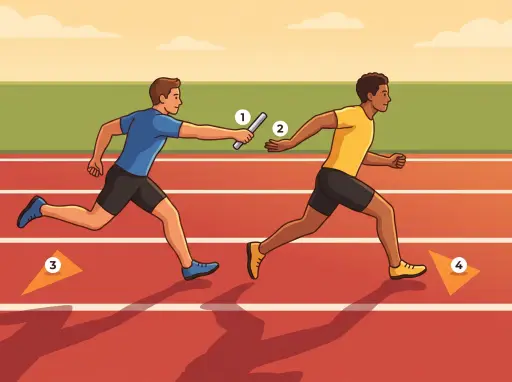
In the picture
- The baton: pushed forward at arm’s length by the incoming runner
- The receiver’s open hand: held still behind the body as a clear target
- Start of the changeover zone: the baton must change hands between the two lines
- The checkmark: when the incoming runner reaches it, the receiver starts sprinting
Examples
- Olympic 4×100 m relay finals, where teams with smooth passes often beat teams with faster individual sprinters
- A school sports-day relay where teams practise their checkmark distance before race day
Key takeaways
- In the 4×100 m, the baton must change hands inside a 30 m zone, judged by where the baton is.
- The receiver looks ahead, not back, and trusts the incoming runner to place the baton in their hand.
Quiz: The Perfect Baton Pass (Age 18)
-
In a sprint relay, why does the receiving runner start running before the baton arrives?
-
In the 4×100 m relay, what decides whether an exchange happened inside the 30 m changeover zone?
-
During a good exchange, where does the receiver look?
The answers, each with its explanation, are in the app. This quiz is free there while the lesson is in the free week.
Get the app
Free app, optional subscription
App Store Google Play
Carry on in the app
At least one new illustrated lesson every weekday for your child’s year, with its quiz and a reminder at 6:15 pm.
Your child’s teacher does not use My Enhanced Teacher yet?
Tell them about it