Mon Prof Augmenté
Container Ships Move the World
Age 18 · Geography

Around 80% of world trade by volume travels by sea, much of it packed in standard steel containers that move easily between ship, truck and train. Ships follow fixed routes linking huge ports, and many pass through narrow straits where any blockage can disrupt trade worldwide.
This picture is part of the full library
Every lesson is open to everyone for 7 days after it is published. This one came out on October 23, 2026: its text stays readable here, and its picture opens with a subscription.
The app is free. A subscription opens every lesson, in every school year.
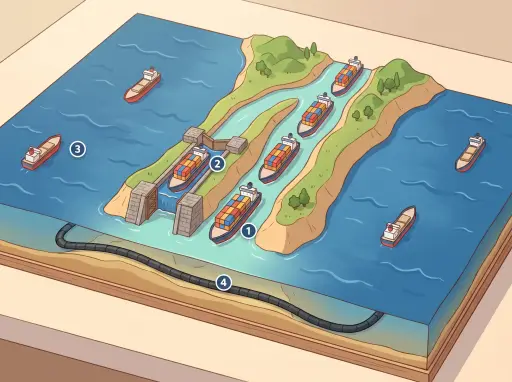
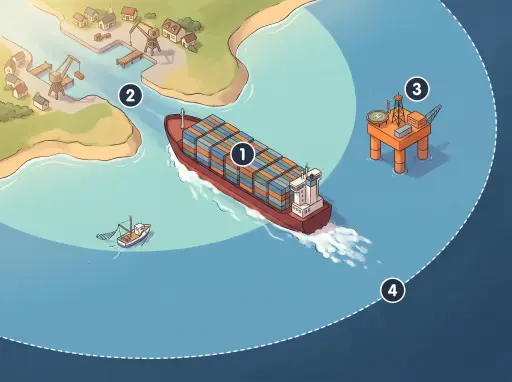
In the picture
- Container ship: standard boxes in two sizes, 20-foot and 40-foot, stacked by the thousand
- Narrow strait: a chokepoint where many shipping routes squeeze through
- Gantry crane: lifts containers between ship and quay in minutes
- Container yard: boxes waiting to leave by truck, train or another ship
Examples
- A phone assembled in China usually reaches European shops in a container, after passing through the Strait of Malacca and the Suez Canal.
- In 2021 the ship Ever Given blocked the Suez Canal for six days, delaying hundreds of ships and goods around the world.
Key takeaways
- Roughly 80% of world trade by volume is carried by sea.
- Straits such as Malacca, Hormuz and Gibraltar are strategic chokepoints for global trade.
Quiz: Container Ships Move the World (Age 18)
-
Roughly what share of world trade by volume is carried by sea?
-
Why are straits such as Malacca, Hormuz and Gibraltar considered strategic for global trade?
-
What makes steel shipping containers so useful for world trade?
The answers, each with its explanation, are in the app. This lesson has left the free week, so its quiz is part of the subscription.
Free app, optional subscription
App Store Google Play
Carry on in the app
At least one new illustrated lesson every weekday for your child’s year, with its quiz and a reminder at 6:15 pm.
Your child’s teacher does not use My Enhanced Teacher yet?
Tell them about it