Mon Prof Augmenté
Area Under a Curve with Signs
Age 17 · Maths
Open to everyone until Monday, November 16
To keep it, print it while it is open.
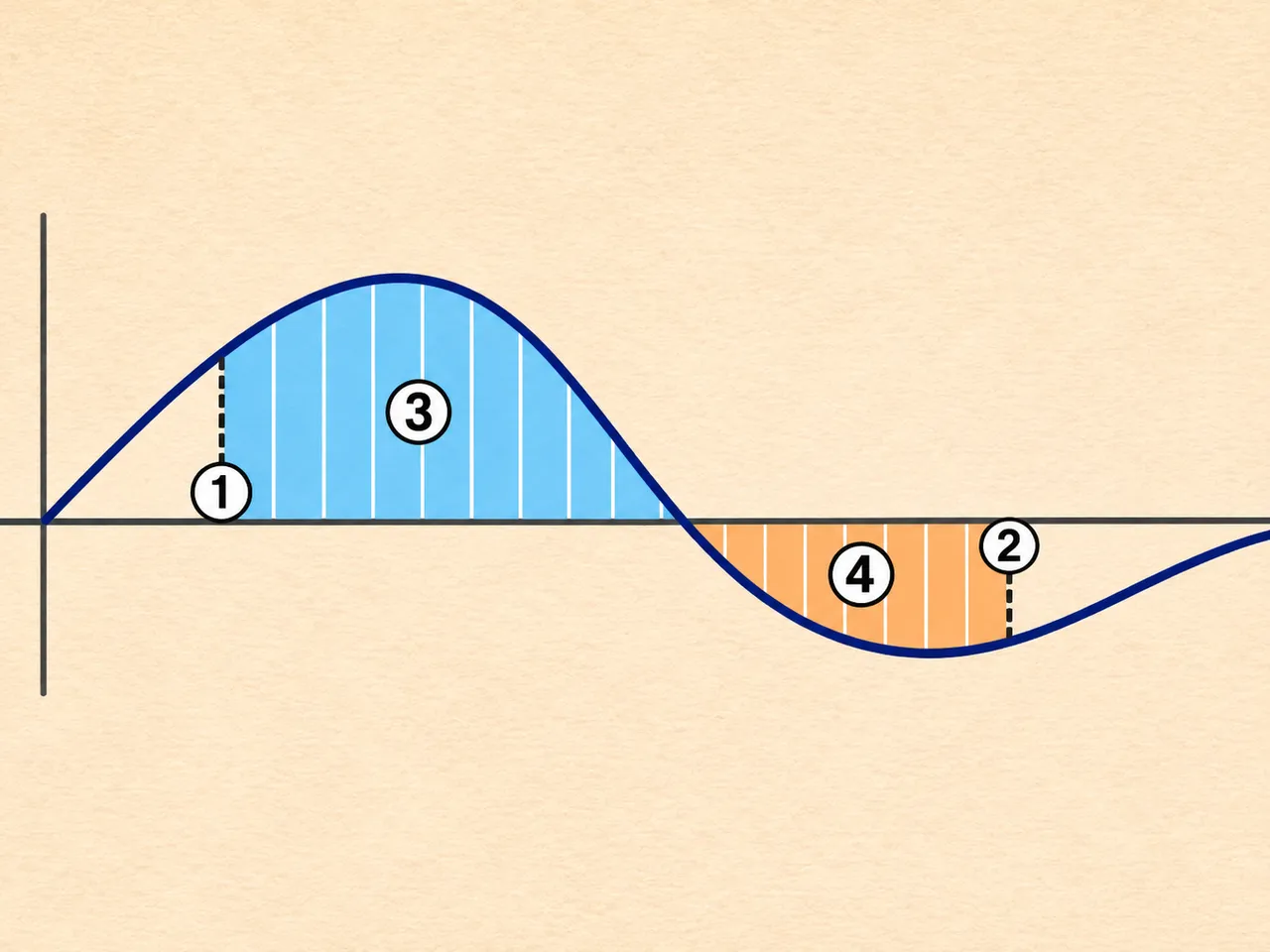
A definite integral adds up the area between a curve and the x-axis from x = a to x = b, but area below the axis counts as negative. You don’t need to add up the thin strips one by one: find an antiderivative F and work out F(b) − F(a).
In the picture
- Lower limit a: where the integration starts, the value you put into F(a)
- Upper limit b: where the integration ends, the value you put into F(b)
- Region above the x-axis: this area is counted as positive
- Region below the x-axis: this area is counted as negative and is taken away from the total
Examples
- On a velocity–time graph, the integral gives a car’s net displacement: driving forward adds distance and reversing takes it away.
- If a tank’s flow rate is positive while water comes in and negative while it drains, the integral gives the net change in volume.
Key takeaways
- ∫ from a to b of f(x) dx = F(b) − F(a), where F′(x) = f(x).
- An integral gives the net signed area. To get the total geometric area, integrate |f(x)|.
Carry on in the app
At least one new illustrated lesson every weekday for your child’s year, with its quiz and a reminder at 6:15 pm.
Get the app
Free app, optional subscription
App Store Google Play
Your child’s teacher does not use My Enhanced Teacher yet?
Tell them about it