Mon Prof Augmenté
Three Squares on a Right Triangle
Age 13 · Maths
Open to everyone until Wednesday, November 18
To keep it, print it while it is open.
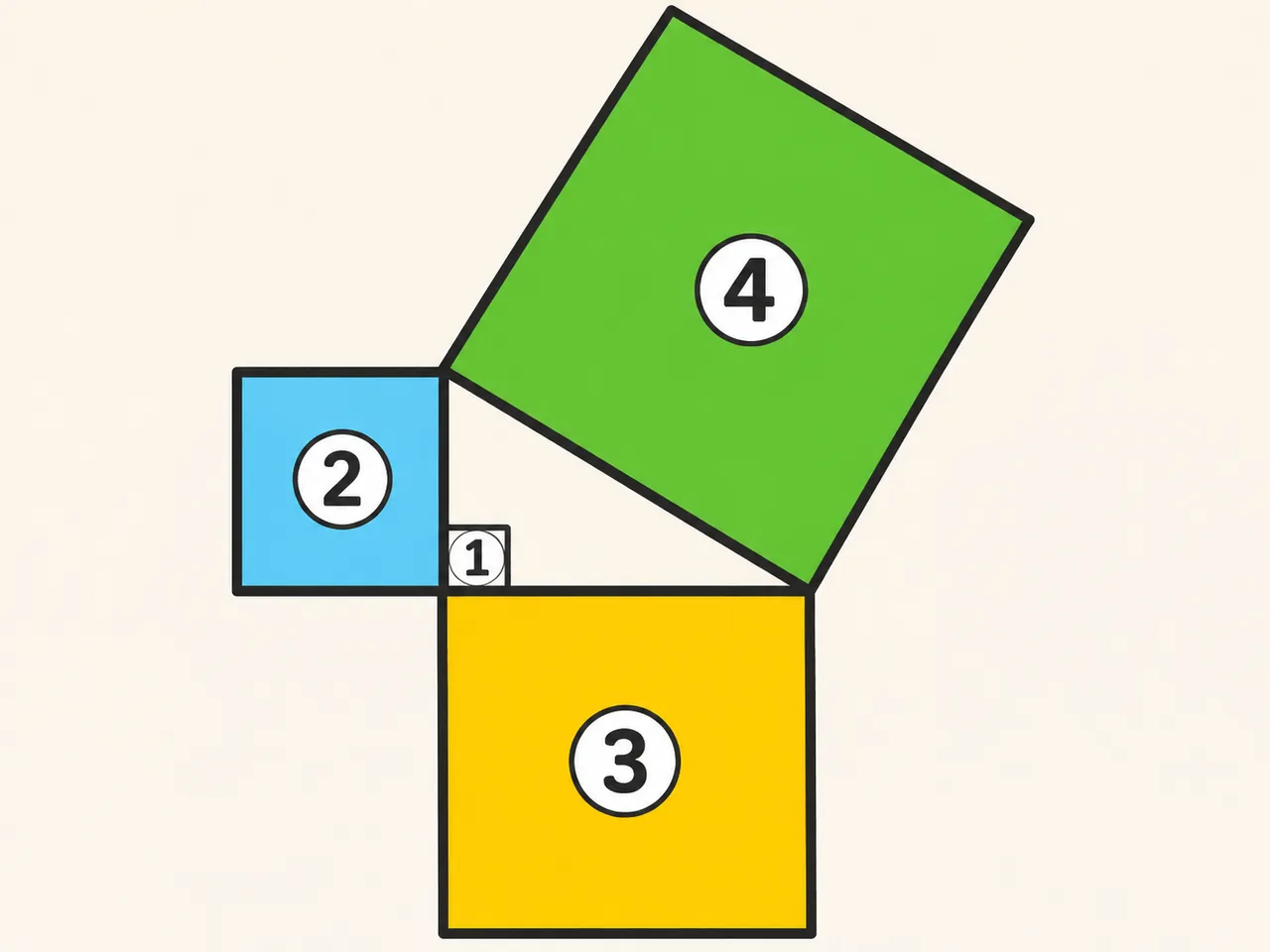
In a right triangle, the longest side is called the hypotenuse, and the square built on it has exactly the same area as the two smaller squares put together. For sides of 3, 4 and 5, that means 9 + 16 = 25.
In the picture
- The right angle: the two shorter sides meet at 90°
- Square on the side of length 3: area 3 × 3 = 9
- Square on the side of length 4: area 4 × 4 = 16
- Square on the hypotenuse, length 5: area 5 × 5 = 25, the same as 9 + 16
Examples
- Leaning a ladder against a wall: the ladder is the hypotenuse, and the theorem tells you how high up it reaches.
- Walking diagonally across a rectangular park is shorter than walking along two of its edges.
Key takeaways
- a² + b² = c², where c is the side opposite the right angle.
- The theorem only works for triangles with a right angle.
Quiz: Three Squares on a Right Triangle (Age 13)
-
In a right triangle, which side is the hypotenuse?
-
In a right triangle, the squares on the two shorter sides have areas of 36 and 64. What is the area of the square on the hypotenuse?
-
For which triangles does the rule a² + b² = c² work?
The answers, each with its explanation, are in the app. This quiz is free there while the lesson is in the free week.
Get the app
Free app, optional subscription
App Store Google Play
Carry on in the app
At least one new illustrated lesson every weekday for your child’s year, with its quiz and a reminder at 6:15 pm.
Your child’s teacher does not use My Enhanced Teacher yet?
Tell them about it