Mon Prof Augmenté
The Squares on a Right Triangle
Age 13 · Maths

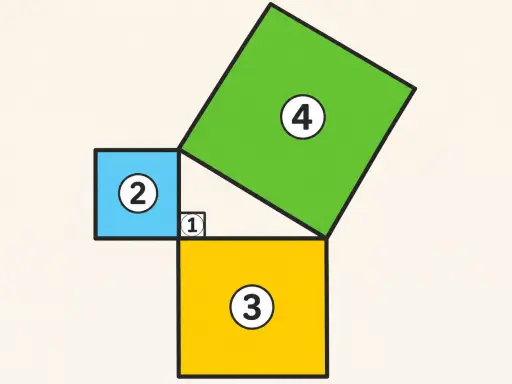
In a right-angled triangle, the longest side is called the hypotenuse, and it is always opposite the right angle. If you build a square on each side, the area of the biggest square is exactly the area of the two smaller squares added together.
This picture is part of the full library
Every lesson is open to everyone for 7 days after it is published. This one came out on October 27, 2026: its text stays readable here, and its picture opens with a subscription.
The app is free. A subscription opens every lesson, in every school year.
Age 13: open this week
Browse Age 13

In the picture
- The right angle: the square corner where the two shorter sides meet
- Square on the side of length 3: area 3 × 3 = 9
- Square on the side of length 4: area 4 × 4 = 16
- Square on the hypotenuse, length 5: area 5 × 5 = 25, which equals 9 + 16
Examples
- A ladder leaning against a wall: knowing how high it reaches and how far its foot is from the wall tells you how long the ladder is.
- A TV screen’s size is measured along its diagonal, which you can work out from its width and height.
Key takeaways
- a² + b² = c², where c is the hypotenuse
- It only works for triangles with a right angle
Quiz: The Squares on a Right Triangle (Age 13)
-
In a right-angled triangle, which side is the hypotenuse?
-
In a right-angled triangle, the squares on the two shorter sides have areas of 9 and 16. What is the area of the square on the hypotenuse?
-
Which triangles does the rule a² + b² = c² work for?
The answers, each with its explanation, are in the app. This lesson has left the free week, so its quiz is part of the subscription.
Free app, optional subscription
App Store Google Play
Carry on in the app
At least one new illustrated lesson every weekday for your child’s year, with its quiz and a reminder at 6:15 pm.
Your child’s teacher does not use My Enhanced Teacher yet?
Tell them about it