Mon Prof Augmenté
A Robot Arm That Corrects Itself
Age 17 · Technology
Open to everyone until Sunday, November 15
To keep it, print it while it is open.
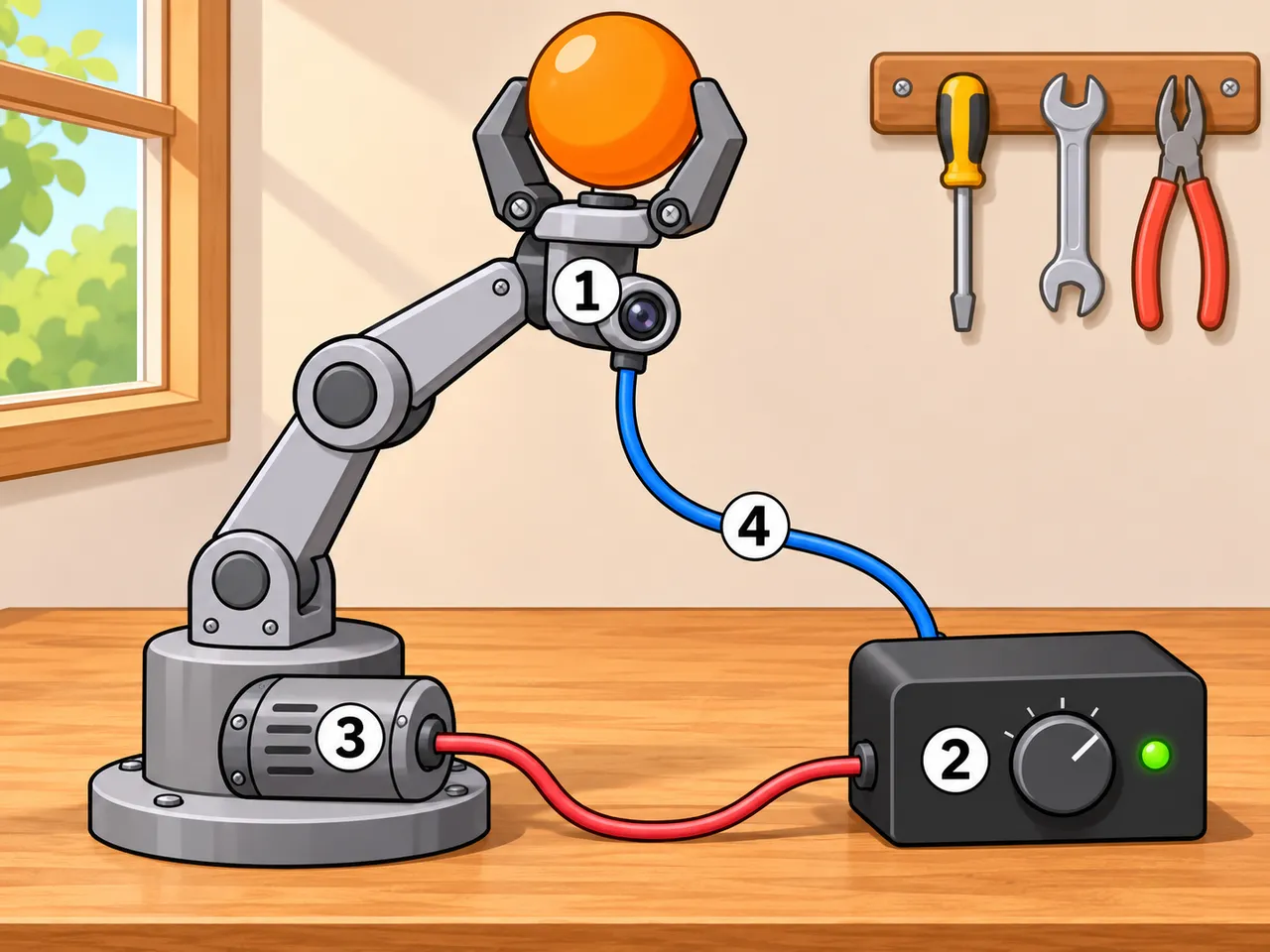
In closed-loop control, a sensor measures what the system is actually doing and feeds that value back to a controller. The controller compares it with the target (the setpoint) and drives the actuator to shrink the difference.
In the picture
- Sensor: measures the real height of the ball
- Controller: compares the measurement with the setpoint dial and computes a correction
- Actuator (motor): moves the arm according to the correction
- Feedback cable: carries the measured output back to the controller, closing the loop
Examples
- A thermostat measures room temperature and switches the heating on or off to reach the temperature you set.
- Cruise control reads the car’s speed and adjusts the throttle to hold the speed you chose, even uphill.
Key takeaways
- Feedback lets a system correct its own error, using the gap between setpoint and measured output.
- Without the return path from sensor to controller, the system is open-loop and cannot react to disturbances.
Quiz: A Robot Arm That Corrects Itself (Age 17)
-
In a closed-loop system, what does the controller compare in order to decide how to correct?
-
What turns a feedback system into an open-loop system that cannot react to disturbances?
-
A disturbance pushes the system away from its target. Why can a closed-loop system recover on its own?
The answers, each with its explanation, are in the app. This quiz is free there while the lesson is in the free week.
Get the app
Free app, optional subscription
App Store Google Play
Carry on in the app
At least one new illustrated lesson every weekday for your child’s year, with its quiz and a reminder at 6:15 pm.
Your child’s teacher does not use My Enhanced Teacher yet?
Tell them about it