Mon Prof Augmenté
Thales’s theorem in nested triangles
Age 14 · Maths

When a line parallel to the base of a triangle cuts the two other sides, it creates a smaller triangle with sides in proportion to the big one. This lets you find an unknown length by writing an equality of ratios.
This picture is part of the full library
Every lesson is open to everyone for 7 days after it is published. This one came out on November 2, 2026: its text stays readable here, and its picture opens with a subscription.
The app is free. A subscription opens every lesson, in every school year.

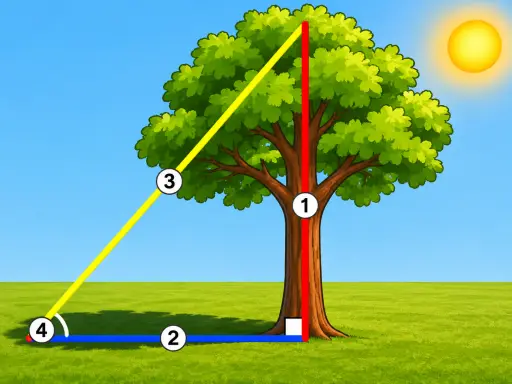
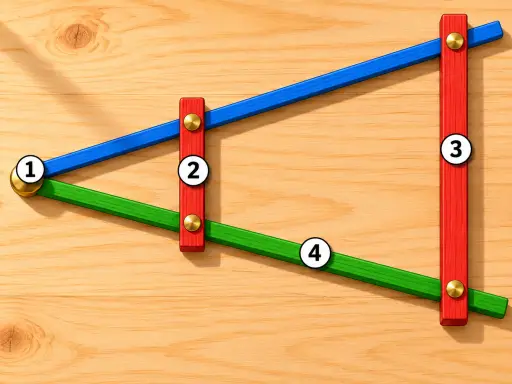
In the picture
- The shared corner: the point where both lines start
- The small base: the parallel line cutting the two sides
- The large base: the side the parallel line is parallel to
- The upper segment: the part of the side from the corner to the parallel line
- The lower segment: the rest of the side, from the parallel line to the large base
Examples
- Finding the height of a tree from the length of its shadow next to a small stick
- Finding the width of a river by using a smaller triangle drawn on the bank
Key takeaways
- If the small base is parallel to the large one, then upper segment ÷ whole side = small base ÷ large base
- Cross-multiply the ratios to calculate any unknown length
Quiz: Thales’s theorem in nested triangles (Age 14)
-
For Thales’s theorem to work in nested triangles, what must be true about the small base?
-
Which equality is correct for the upper segment, the whole side, the small base and the large base?
-
You know three of the four lengths in an equality of ratios. How do you find the unknown one?
The answers, each with its explanation, are in the app. This lesson has left the free week, so its quiz is part of the subscription.
Free app, optional subscription
App Store Google Play
Carry on in the app
At least one new illustrated lesson every weekday for your child’s year, with its quiz and a reminder at 6:15 pm.
Your child’s teacher does not use My Enhanced Teacher yet?
Tell them about it