Mon Prof Augmenté
From Gears to Microchips
Open to everyone until Wednesday, September 30
To keep it, print it while it is open.
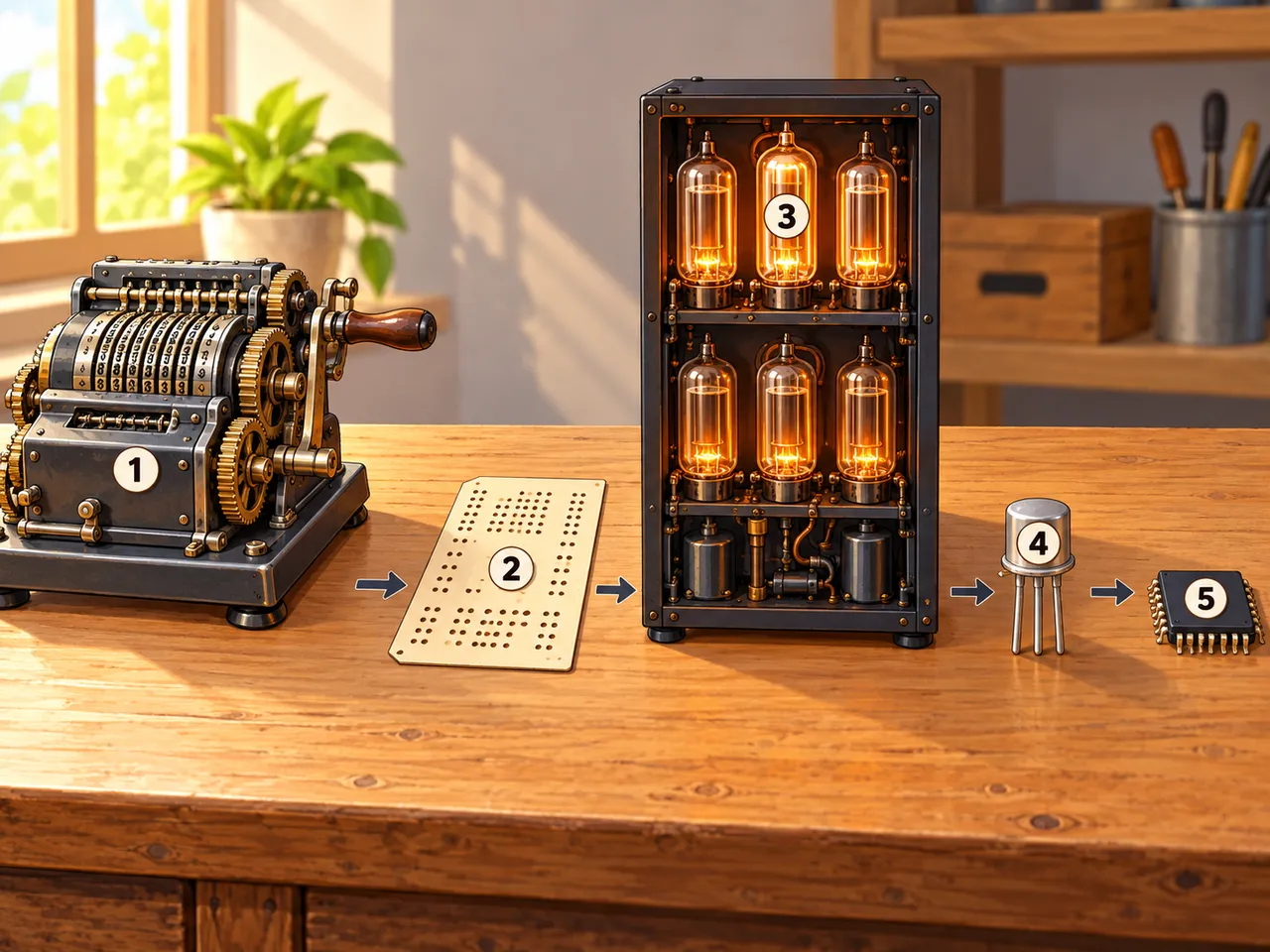
Early calculators used hand-turned gears to do arithmetic, while later machines relied on thousands of vacuum tubes. Transistors and then microchips made computing smaller, faster, and far more reliable.
In the picture
- A hand-cranked calculator: turning gears performs arithmetic step by step.
- A punched paper sheet: holes store instructions or numbers for a machine to read.
- A vacuum tube: an early electronic switch that glows and controls current in a large machine.
- A transistor: a small solid switch that replaces fragile vacuum tubes.
- A silicon microchip: many transistors built together on one tiny piece of silicon.
Examples
- A pocket calculator and a smartphone both perform arithmetic, but they use modern chips instead of gears or tubes.
- A laptop’s processor contains millions of transistors on a single silicon chip.
Key takeaways
- Mechanical calculators used gears; vacuum-tube computers used glowing tubes.
- Transistors and microchips made computers smaller, faster, and more reliable.
Carry on in the app
Three questions on this lesson, to check the idea stuck. Free in the app while the lesson is in the free week.
At least one new illustrated lesson every weekday for your child’s year, with its quiz and a reminder at 6:15 pm.
Get the app
Free app, optional subscription
App Store Google Play