Mon Prof Augmenté
Counting successes on a Galton board
Age 18 · Maths
Open to everyone until Wednesday, November 18
To keep it, print it while it is open.
The binomial distribution B(n, p) gives the number of successes X in n independent trials, where each trial succeeds with the same probability p. Its mean is np and its variance is np(1−p), so outcomes cluster around np and grow rarer the further they lie from it.
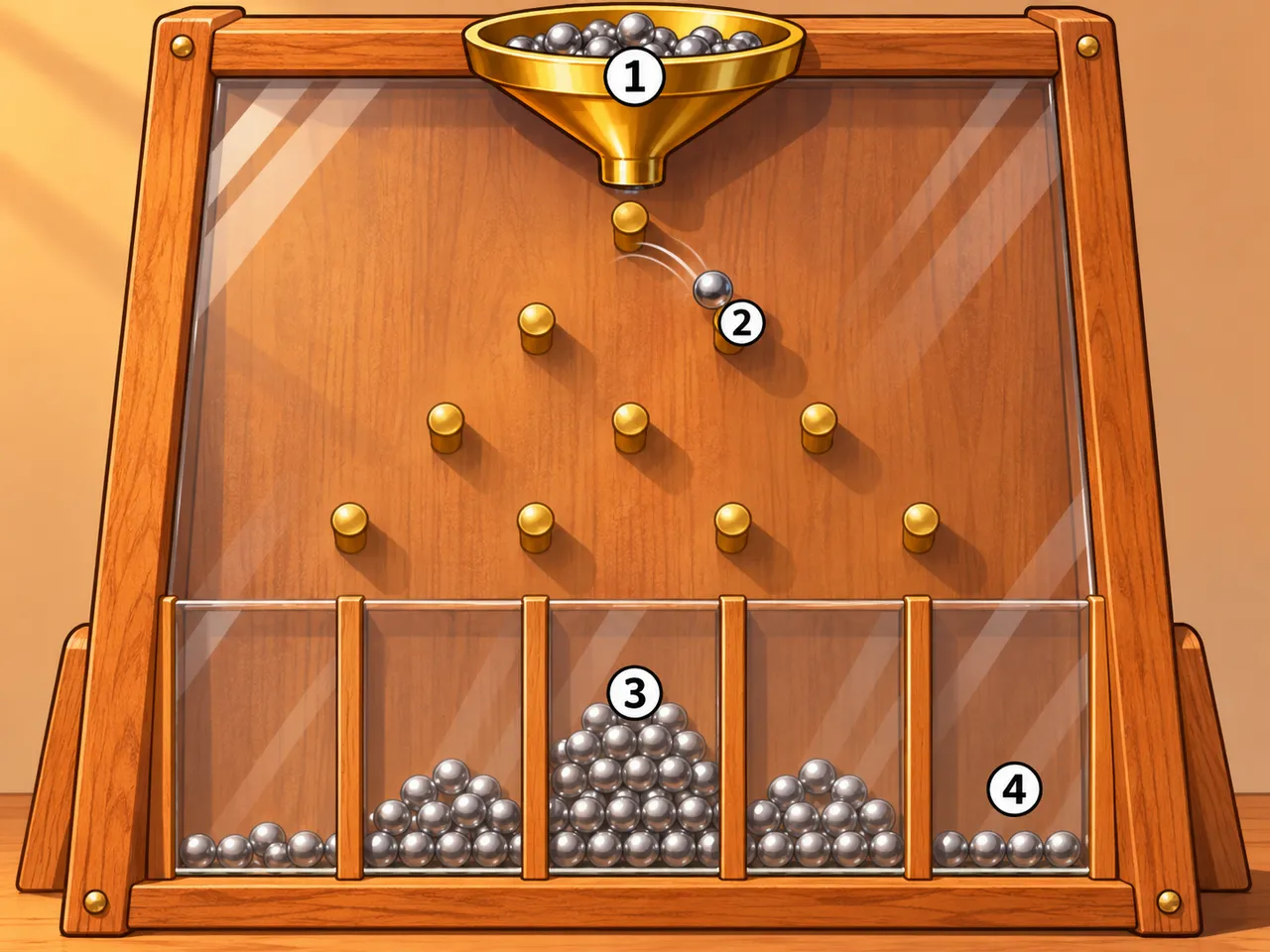
In the picture
- The funnel: each ball released runs one full set of n trials
- A peg: one Bernoulli trial, bouncing right (success, probability p) or left (failure, probability 1−p)
- The middle bin: the tallest heap sits at the mean np
- An outer bin: its shallow heap shows how far results spread, measured by the variance np(1−p)
Examples
- Flipping a fair coin 10 times and counting heads: X ~ B(10, 0.5), with mean 5 and variance 2.5.
- A basketball player who makes 70% of free throws takes 20 shots: on average they make 14, with variance 4.2.
Key takeaways
- For X ~ B(n, p): mean np, variance np(1−p), and P(X = k) = C(n, k) p^k (1−p)^(n−k).
- The model only works if the trials are independent and every trial has the same probability p.
Quiz: Counting successes on a Galton board (Age 18)
-
A variable X follows B(20, 0.3). What are its mean and variance?
-
In which of these situations does the binomial model NOT apply?
-
For X ~ B(n, p), around which value do the outcomes cluster?
The answers, each with its explanation, are in the app. This quiz is free there while the lesson is in the free week.
Get the app
Free app, optional subscription
App Store Google Play
Carry on in the app
At least one new illustrated lesson every weekday for your child’s year, with its quiz and a reminder at 6:15 pm.
Your child’s teacher does not use My Enhanced Teacher yet?
Tell them about it