Mon Prof Augmenté
The Strait of Malacca, a sea highway
Age 17 · Geography

Most goods traded around the world travel by sea in giant ships, and many of their routes squeeze through a few narrow passages called straits. The Strait of Malacca, between Malaysia and the Indonesian island of Sumatra, is one of the busiest, linking the Indian Ocean to the Pacific and the factories of East Asia.
This picture is part of the full library
Every lesson is open to everyone for 7 days after it is published. This one came out on October 26, 2026: its text stays readable here, and its picture opens with a subscription.
The app is free. A subscription opens every lesson, in every school year.
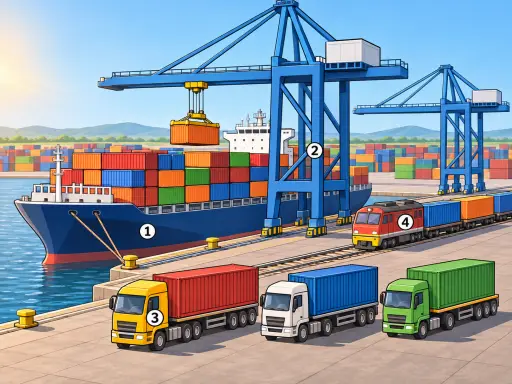
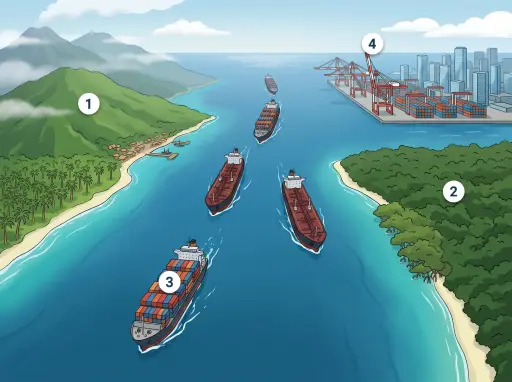
In the picture
- Container ship: standard steel boxes carrying manufactured goods between continents
- Oil tanker: crude oil from the Persian Gulf heading to China, Japan and South Korea
- The strait: a narrow chokepoint that tens of thousands of ships must pass through each year
- Port with cranes: a hub where containers are unloaded, stored and moved onto other ships
Examples
- A smartphone assembled in China reaches a shop in Europe after a voyage through the Strait of Malacca and the Suez Canal.
- Petrol in a car in Tokyo was often refined from oil shipped from the Persian Gulf through the Strait of Malacca.
Key takeaways
- About 80% of world trade by volume travels by sea.
- If a strategic strait is blocked, ships face long and costly detours, so states watch these chokepoints closely.
Quiz: The Strait of Malacca, a sea highway (Age 17)
-
Roughly what share of world trade, measured by volume, travels by sea?
-
Why do states keep a close watch on strategic straits?
-
Which two oceans does the Strait of Malacca link?
The answers, each with its explanation, are in the app. This lesson has left the free week, so its quiz is part of the subscription.
Free app, optional subscription
App Store Google Play
Carry on in the app
At least one new illustrated lesson every weekday for your child’s year, with its quiz and a reminder at 6:15 pm.
Your child’s teacher does not use My Enhanced Teacher yet?
Tell them about it