 Mon Prof Augmenté
Ariane 6 cutaway: how Europe’s heavy-lift rocket works
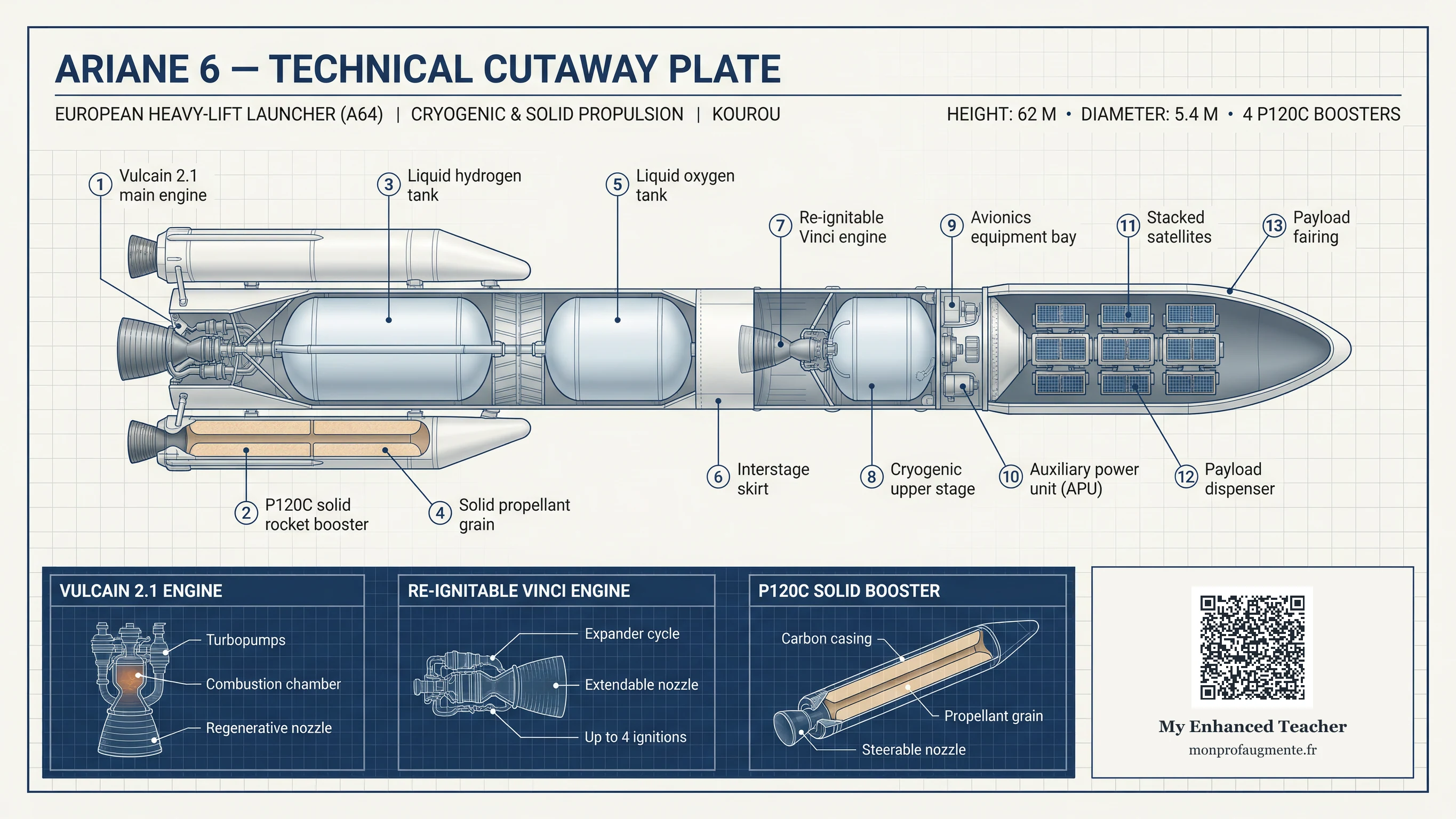
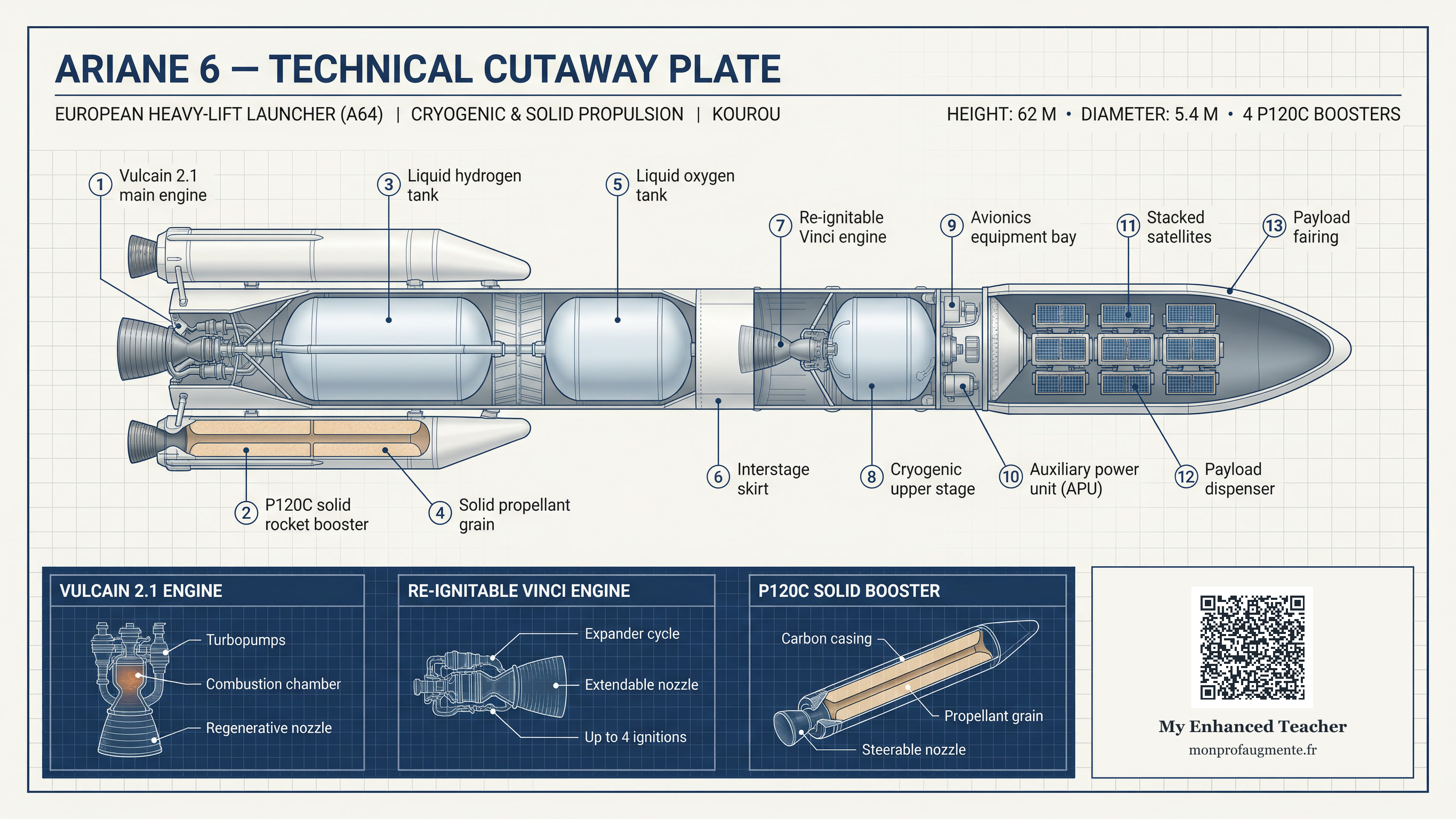
Ariane 6 is Europe’s heavy-lift space launcher built by ArianeGroup for the European Space Agency (ESA) and operated by Arianespace from Kourou, French Guiana. In its heavy Ariane 64 configuration, four P120C solid boosters, a cryogenic core stage and a re-ignitable Vinci upper stage can deploy whole satellite constellations across multiple orbits in a single flight. Each number on the plate is explained below.
See it at full size
On this page the picture is scaled to fit your window. The original is 2730×1536 pixels, about 4 megapixels, so there is much more to see than the page shows at once. Three ways to look closer:
- Press “View at full size”. The viewer opens with the image scaled to your window. Choose Actual pixels to show every pixel of the file, one for one, then drag the picture to move around it. Fit returns to the whole plate. Keys: + and − to zoom, 1 for actual pixels, 0 to fit, Esc to close.
- Open the file itself. Open the full-size image in a new tab. Browsers first show it shrunk to the window. Click the image once to switch to 100 % (Chrome, Edge, Firefox and Safari all do this), then scroll or drag to move around.
- On a phone or tablet, open the full-size image the same way and pinch to zoom. The view is sharp because the file really is that large.
Retina and other high-density screens show an image sharper than its pixel count suggests, so “Actual pixels” shrinks the picture on those screens so that one image pixel really is one screen pixel.
Print it
Do not print from the browser window: it prints the page, not the picture at its full size. Use the downloaded file, which contains all 2730×1536 pixels.
- Download the full-resolution JPEG (0.8 MB).
- Open it in Preview (Mac), Photos (Windows) or any image viewer and choose Print. Do not use the browser’s print preview on this page.
- Set the paper to landscape. Choose Fill page or Scale to fit and keep the proportions. The plate is 16:9, so on A-series paper there will be a white band at the top and bottom, and you should not crop it: the QR code is in the corner.
- Choose the highest print quality, and turn off any “draft” or “save ink” mode.
- For a poster, take the same file to a print shop and ask for the largest size you want. Tell them it is 2730×1536 pixels so they know the sharpness they can expect.
| Paper, long side | Sharpness | Good for |
|---|---|---|
| A4 (297 mm wide) | 233 ppi | Sharp on any printer |
| A3 (420 mm wide) | 165 ppi | Best choice: a wall poster you can read up close |
| A2 (594 mm wide) | 117 ppi | Good from arm’s length |
| A1 (841 mm wide) | 82 ppi | Classroom wall, viewed from a distance |
For a sharp print, aim for 150 ppi or more at the distance you will read it from. Print shops usually want 300 ppi for a close-up look; at A3 this plate reaches 165 ppi.
What each number shows
- Vulcain 2.1 main engine. This cryogenic engine burns liquid hydrogen and liquid oxygen at the base of the core stage. It fires for nearly eight minutes and carries the rocket upward after the solid boosters separate.
- P120C solid rocket booster. Four P120C boosters flank the heavy Ariane 64 configuration (two on Ariane 62). They deliver most of the thrust during the first two minutes of flight before detaching cleanly.
- Liquid hydrogen tank. This large tank stores hydrogen chilled to −253 °C. Very light yet bulky, liquid hydrogen fills most of the main core stage and feeds the Vulcain 2.1 engine.
- Solid propellant grain. Each P120C booster holds roughly 142 tonnes of solid fuel cast inside a filament-wound carbon-fibre casing. Once ignited, it burns continuously until burnout.
- Liquid oxygen tank. Positioned ahead of the hydrogen tank in the core stage, this tank holds oxygen chilled to −183 °C so combustion can continue in the vacuum of space where there is no air.
- Interstage skirt. This cylindrical structure links the core stage to the upper stage. It shields the Vinci engine nozzle during atmospheric ascent and separates when the core stage shuts down.
- Re-ignitable Vinci engine. A defining upgrade on Ariane 6, the cryogenic Vinci engine can restart up to four times in orbit. This lets the rocket place satellites into distinct orbits and then safely de-orbit the upper stage.
- Cryogenic upper stage. Compact and self-contained, this stage carries its own liquid hydrogen and liquid oxygen tanks to guide payloads all the way to low-Earth, medium or geostationary transfer orbit.
- Avionics equipment bay. Acting as the launcher’s brain, the equipment bay houses flight computers, inertial sensors and guidance electronics that steer Ariane 6 along its exact flight path.
- Auxiliary power unit (APU). This small unit pressurises the upper-stage tanks and produces gentle micro-thrust in weightlessness to settle propellants before each Vinci restart.
- Stacked satellites. Inside the fairing, Ariane 6 can launch one large spacecraft or dozens of stacked broadband satellites released sequentially into low Earth orbit.
- Payload dispenser. A custom central structure holds the satellites securely through launch vibrations and releases them cleanly once in space.
- Payload fairing. Standing 20 m tall in the long configuration, this two-half composite shell shields the cargo from aerodynamic forces and heat before splitting away above the dense atmosphere.
Ariane 6 at a glance
| Prime contractor & operator | ArianeGroup for the European Space Agency (ESA); operated by Arianespace |
|---|---|
| Configurations | Ariane 62 (2 P120C boosters) and Ariane 64 (4 P120C boosters) |
| Height & diameter | About 56 to 62 m depending on fairing (14 m or 20 m); 5.4 m core diameter |
| Lift-off mass | Roughly 540 t (A62) to 860 t (A64) |
| Propulsion | 1 cryogenic Vulcain 2.1, 2 or 4 P120C solid boosters, 1 re-ignitable Vinci engine |
| Payload capacity | Up to 21.6 t to low Earth orbit and 11.5 t to geostationary transfer orbit (A64) |
| Launch site | Europe’s Spaceport, Kourou (French Guiana) |
Sources: ESA — Ariane 6, Arianespace and Wikipedia. The drawing shows the heavy Ariane 64 configuration (20 m fairing) in a simplified horizontal cutaway so internal tanks, engines and stacked satellites are easy to inspect.