 Mon Prof Augmenté
A volcano in cutaway: how it works
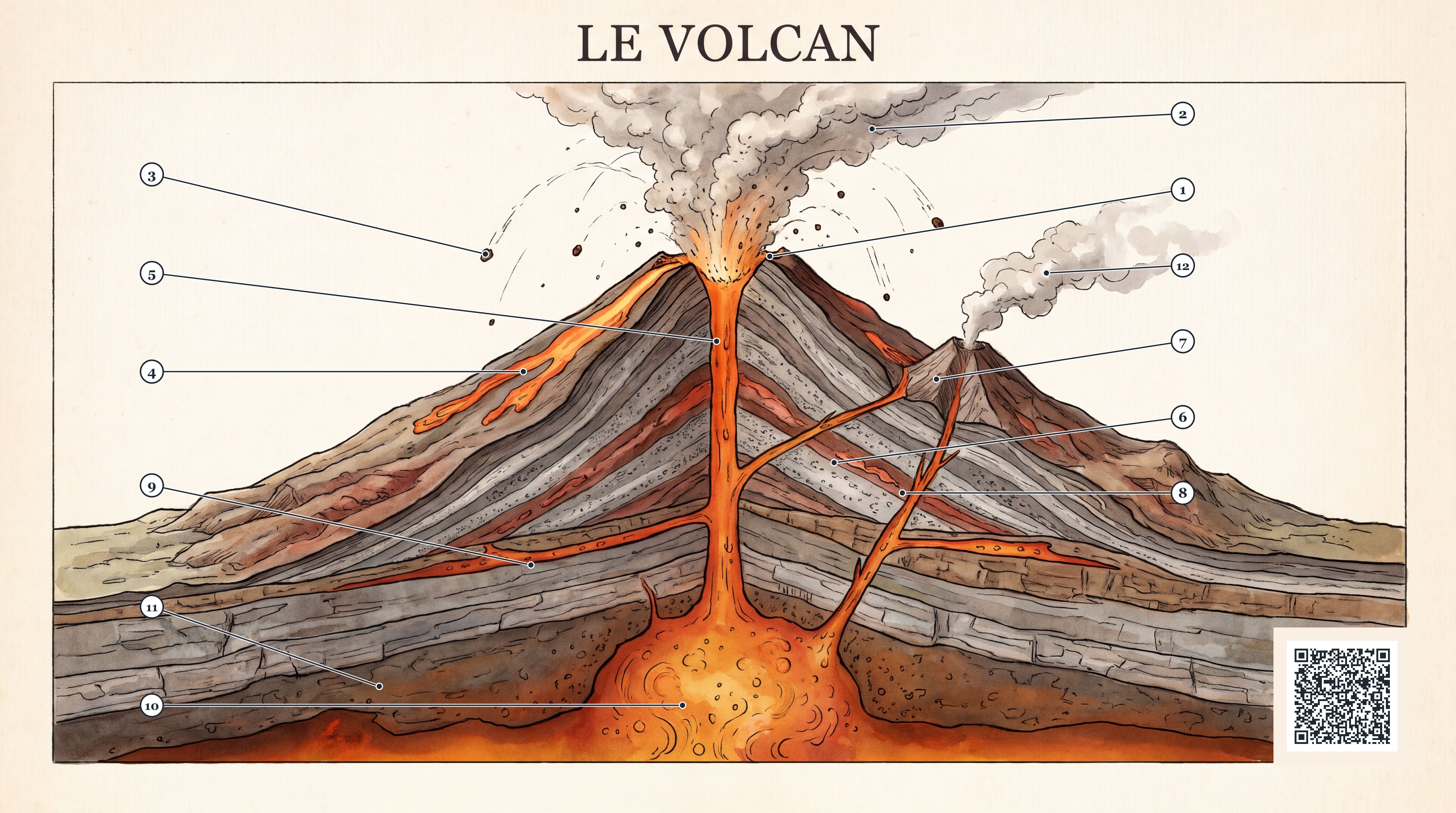
A volcano is an opening in the Earth’s crust where molten rock, ash and gas escape from underground. The volcano drawn here is a stratovolcano, the tall, steep kind built up over thousands of years by many eruptions. This plate slices the mountain open to show the path the magma follows, from a chamber deep below to the crater at the top. Each number on the picture is explained in the list below.

See it at full size
On this page the picture is scaled to fit your window. The original is 5504×3072 pixels, about 17 megapixels, so there is much more to see than the page shows at once. Three ways to look closer:
- Press “View at full size”. The viewer opens with the image scaled to your window. Choose Actual pixels to show every pixel of the file, one for one, then drag the picture to move around it. Fit returns to the whole plate. Keys: + and − to zoom, 1 for actual pixels, 0 to fit, Esc to close.
- Open the file itself. Open the full-size image in a new tab. Browsers first show it shrunk to the window. Click the image once to switch to 100 % (Chrome, Edge, Firefox and Safari all do this), then scroll or drag to move around.
- On a phone or tablet, open the full-size image the same way and pinch to zoom. The view is sharp because the file really is that large.
Retina and other high-density screens show an image sharper than its pixel count suggests, so “Actual pixels” shrinks the picture on those screens so that one image pixel really is one screen pixel.
Print it
Do not print from the browser window: it prints the page, not the picture at its full size. Use the downloaded file, which contains all 5504×3072 pixels.
- Download the full-resolution JPEG (3.0 MB).
- Open it in Preview (Mac), Photos (Windows) or any image viewer and choose Print. Do not use the browser’s print preview on this page.
- Set the paper to landscape. Choose Fill page or Scale to fit and keep the proportions. The plate is 16:9, so on A-series paper there will be a white band at the top and bottom, and you should not crop it: the QR code is in the corner.
- Choose the highest print quality, and turn off any “draft” or “save ink” mode.
- For a poster, take the same file to a print shop and ask for the largest size you want. Tell them it is 5504×3072 pixels so they know the sharpness they can expect.
| Paper, long side | Sharpness | Good for |
|---|---|---|
| A4 (297 mm wide) | 471 ppi | Sharp on any printer |
| A3 (420 mm wide) | 333 ppi | Best choice: a wall poster you can read up close |
| A2 (594 mm wide) | 235 ppi | Good from arm’s length |
| A1 (841 mm wide) | 166 ppi | Classroom wall, viewed from a distance |
For a sharp print, aim for 150 ppi or more at the distance you will read it from. Print shops usually want 300 ppi for a close-up look; at A3 this plate reaches 333 ppi.
What each number shows
- Crater. The crater is the bowl-shaped opening at the top of the volcano, where the conduit reaches the surface. Lava, ash and gas burst out of it during an eruption.
- Ash cloud. Ash is made of tiny fragments of rock and volcanic glass, smaller than 2 millimetres. Gas pushes it high into the air in a tall cloud, and the wind can carry it a very long way.
- Volcanic bombs. Volcanic bombs are lumps of molten rock thrown out of the crater. They are more than about 6 centimetres across, and they cool and harden as they fly through the air.
- Lava flow. Magma that reaches the surface is called lava. It flows down the slope as a glowing river, at a temperature of roughly 700 to 1,200 degrees Celsius, and slowly cools into solid rock.
- Conduit. The conduit is the long channel that carries magma upward from the chamber to the crater. It acts like a pipe, and the gas in the magma helps push it up.
- Layers of ash and lava. A stratovolcano grows layer by layer. Each eruption adds a new layer of ash or a lava flow on top of the older ones, and the layers pile up into a cone. Their name comes from the Latin word for layer, stratum.
- Side cone. A side cone is a small volcano that grows on the flank of the main one. It is fed by a branch of the main conduit and has its own small crater.
- Dike. A dike is a sheet of magma that cuts across the rock layers. It forces its way through cracks and sometimes feeds a side cone.
- Sill. A sill is a sheet of magma that slides in between two rock layers and runs parallel to them. When it cools, it forms a flat slab of hard rock inside the mountain.
- Magma chamber. The magma chamber is a large reservoir of molten rock, a few kilometres underground. Magma collects there until the pressure is high enough to push it up the conduit.
- Crust. The Earth’s crust is its thin outer layer of solid rock. The volcano is built on top of it, and the magma chamber sits inside it.
- Gas and steam plume. Magma holds dissolved gases, mostly water vapour with some carbon dioxide and sulphur dioxide. They escape from craters as a plume, even from a small side cone between big eruptions.
The volcano at a glance
| Type shown | Stratovolcano (also called a composite volcano): tall and steep, made of alternating layers of lava and ash |
|---|---|
| Examples | Mount Fuji (Japan), Vesuvius (Italy), Mount St. Helens (United States) |
| Magma and lava | Molten rock is called magma underground and lava once it reaches the surface |
| Lava temperature | Roughly 700 to 1,200 degrees Celsius, depending on the type of lava |
| How often | Typically around 50 to 70 volcanoes erupt in a given year |
| Where | Roughly three quarters of the world’s active volcanoes lie around the Pacific Ocean, in the “Ring of Fire” |
Sources: Wikipedia, Volcano and USGS, Volcano Hazards Program. The drawing is a simplified illustration for learning. Real volcanoes vary a lot in shape and in how they erupt, and the mantle, far below the crust, is not shown. Never approach an active volcano: follow the instructions of local authorities.