Mon Prof Augmenté
Heat Trapped in the Air
Age 18 · Science

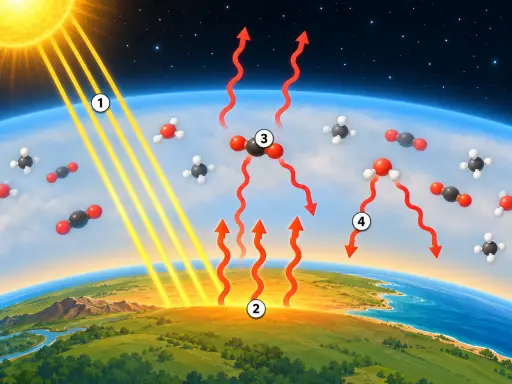
Carbon dioxide and methane molecules in the atmosphere absorb infrared radiation rising from Earth’s surface. They re-emit some of that energy back downward, so the surface becomes warmer than it would be without those gases.
This picture is part of the full library
Every lesson is open to everyone for 7 days after it is published. This one came out on October 5, 2026: its text stays readable here, and its picture opens with a subscription.
The app is free. A subscription opens every lesson, in every school year.
Age 18: open this week
Browse Age 18
In the picture
- A yellow sun ray passing through the atmosphere: incoming solar energy reaches Earth’s surface.
- A carbon dioxide molecule in the atmosphere: it absorbs and re-emits infrared heat.
- A methane molecule in the atmosphere: it absorbs and re-emits infrared heat.
- A red wavy arrow rising from land: infrared heat leaves the warmed surface.
- A red wavy arrow escaping into space: some infrared heat is not absorbed and leaves the atmosphere.
Examples
- A car parked in the sun gets hotter inside because glass slows heat from escaping.
- A greenhouse stays warm because glass lets sunlight in but slows heat from leaving.
Key takeaways
- More carbon dioxide and methane in the air increase the amount of infrared heat returned to the surface.
- This added heat raises Earth’s average surface temperature.
Quiz: Heat Trapped in the Air (Age 18)
-
What do carbon dioxide and methane molecules do to infrared heat in the atmosphere?
-
What happens when there is more carbon dioxide and methane in the air?
-
What happens to infrared heat that is not absorbed in the atmosphere?
The answers, each with its explanation, are in the app. This lesson has left the free week, so its quiz is part of the subscription.
Free app, optional subscription
App Store Google Play
Carry on in the app
At least one new illustrated lesson every weekday for your child’s year, with its quiz and a reminder at 6:15 pm.
Your child’s teacher does not use My Enhanced Teacher yet?
Tell them about it