Mon Prof Augmenté
How the Greenhouse Effect Traps Heat
Age 18 · Science
Open to everyone until Thursday, October 29
To keep it, print it while it is open.
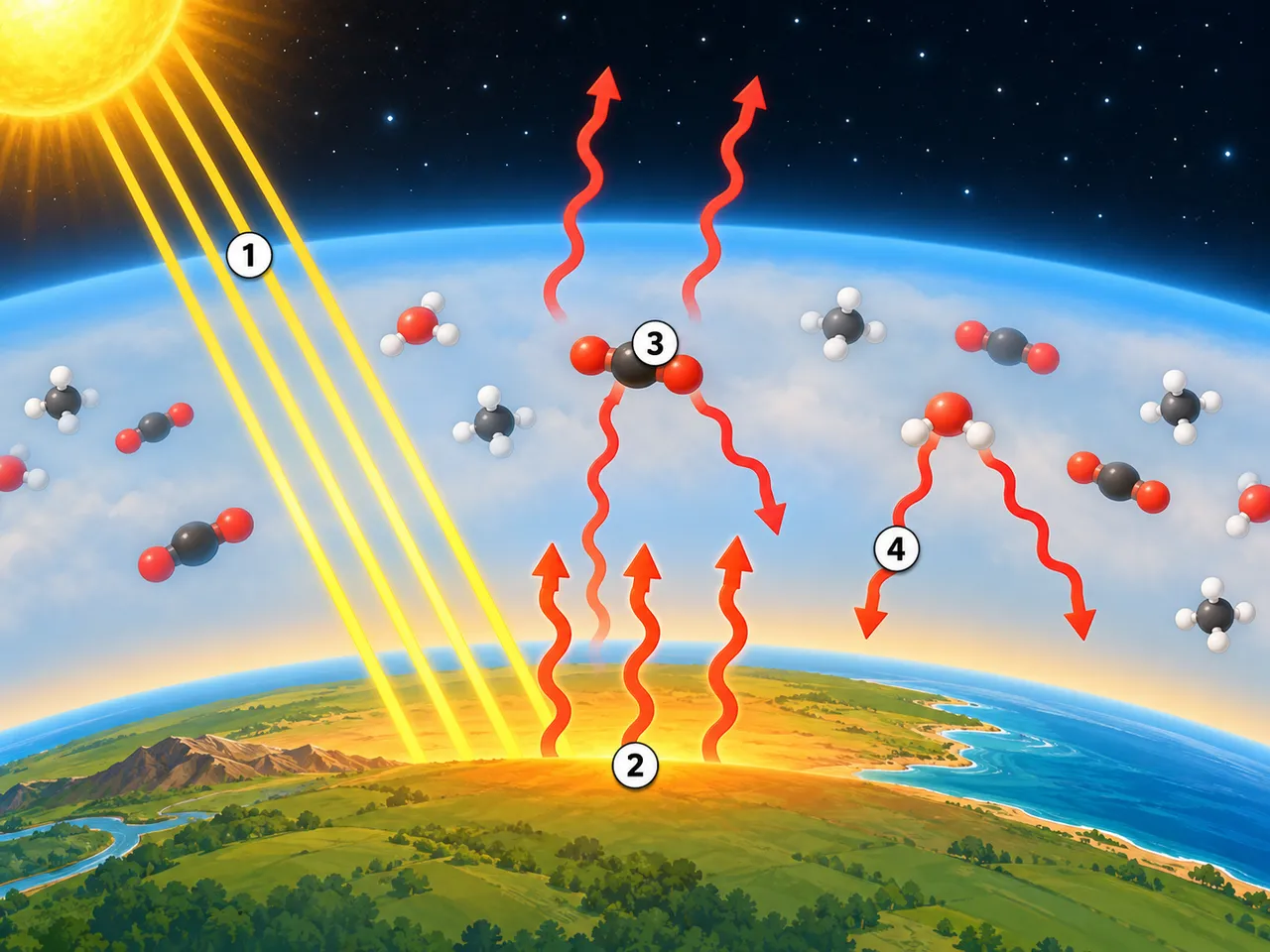
Sunlight passes through the atmosphere and warms the ground, which then gives off heat as infrared radiation. Gases like CO2, methane and water vapour absorb some of that infrared and re-emit part of it back down, keeping the surface warmer than it would otherwise be.
In the picture
- Incoming sunlight: mostly visible light that passes through the air and warms the ground
- Warm surface: land and ocean give off energy as infrared radiation
- Greenhouse gas molecule: CO2, methane or water vapour absorbs infrared
- Returning infrared: part of the absorbed energy is sent back down to the surface
Examples
- A car parked in the sun gets much hotter inside than the outside air.
- Cloudy nights stay warmer than clear nights because water vapour and clouds hold back infrared from the ground.
Key takeaways
- Without any greenhouse effect, Earth’s average surface temperature would be about -18 °C instead of about +15 °C.
- Adding more CO2 and methane strengthens the effect, which drives global warming.
Quiz: How the Greenhouse Effect Traps Heat (Age 18)
-
After sunlight warms the land and ocean, what kind of energy do they give off?
-
What do gases like CO2, methane and water vapour do with the infrared given off by the surface?
-
Without any greenhouse effect, what would Earth’s average surface temperature be?
The answers, each with its explanation, are in the app. This quiz is free there while the lesson is in the free week.
Get the app
Free app, optional subscription
App Store Google Play
Carry on in the app
At least one new illustrated lesson every weekday for your child’s year, with its quiz and a reminder at 6:15 pm.
Your child’s teacher does not use My Enhanced Teacher yet?
Tell them about it