Mon Prof Augmenté
Titration followed with a pH meter
Age 17 · Chemistry
Open to everyone until Tuesday, November 24
To keep it, print it while it is open.
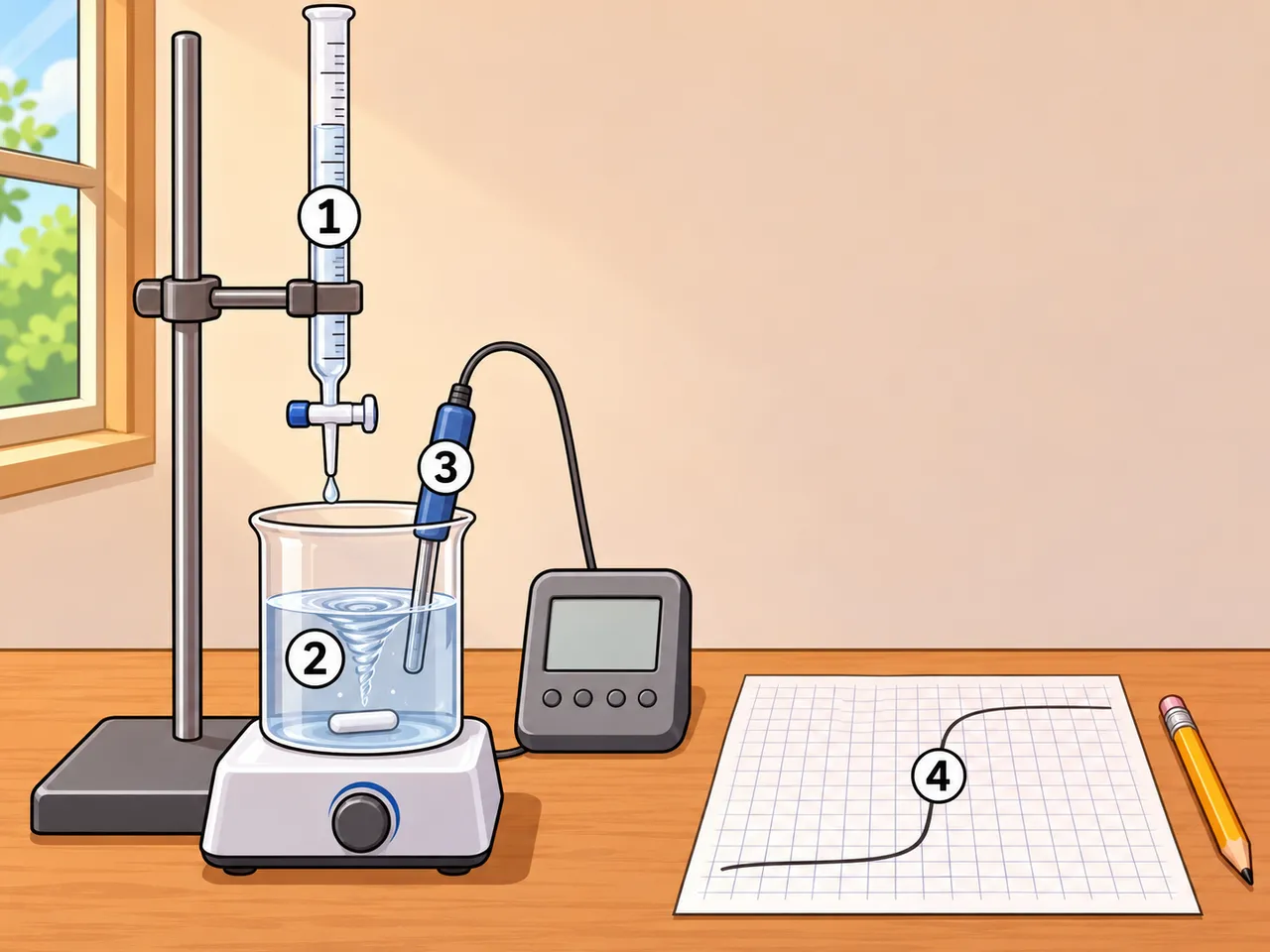
In a titration, a solution of known concentration is added little by little from a burette to a solution of unknown concentration, while a pH meter records the pH. The pH changes slowly, then jumps sharply: the middle of that jump is the equivalence point, where acid and base have reacted in exact proportions.
In the picture
- Burette: delivers the titrant, of known concentration, and shows the volume added
- Beaker on the stirrer: the solution being analysed, mixed constantly by the spinning bar
- pH probe: measures the pH of the mixture after each addition
- Steep jump of the curve: its midpoint gives the volume at equivalence
Examples
- A food lab titrates vinegar with sodium hydroxide to check how much acetic acid it contains.
- A winemaker titrates a sample of wine to measure its total acidity.
Key takeaways
- At equivalence, the titrant added has reacted exactly with all of the substance being analysed.
- The volume read at the middle of the pH jump lets you calculate the unknown concentration.
Quiz: Titration followed with a pH meter (Age 17)
-
In a titration followed with a pH meter, what is true at the equivalence point?
-
On the pH curve of a titration, where do you read the volume at equivalence?
-
What must be known about the solution in the burette for the titration to work?
The answers, each with its explanation, are in the app. This quiz is free there while the lesson is in the free week.
Free app, optional subscription
App Store Google Play
Carry on in the app
At least one new illustrated lesson every weekday for your child’s year, with its quiz and a reminder at 6:15 pm.
Your child’s teacher does not use My Enhanced Teacher yet?
Tell them about it