Mon Prof Augmenté
Finding a concentration by titration
Age 17 · Chemistry
Open to everyone until Sunday, November 15
To keep it, print it while it is open.
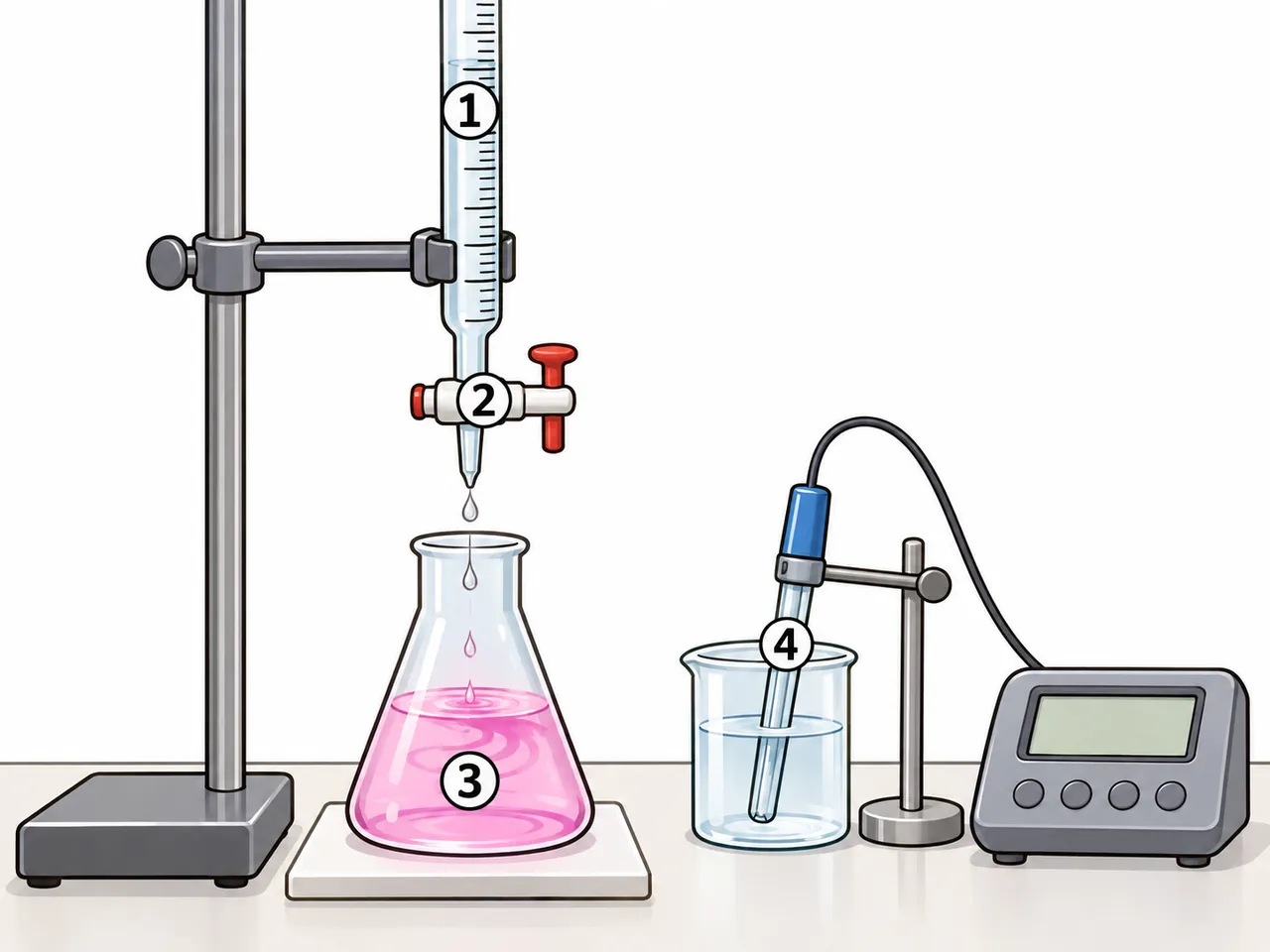
In a titration you slowly add a solution of known concentration to a measured volume of an unknown one until the reaction is exactly complete. From the volume added you can calculate the unknown concentration.
In the picture
- Burette: holds the titrant of known concentration and shows the volume added
- Stopcock: controls the flow, drop by drop, near the end
- Conical flask: the sample with indicator, which changes colour at equivalence
- pH probe: tracks the pH, which jumps sharply at equivalence
Examples
- Measuring the acid content of vinegar with sodium hydroxide
- Checking the acidity of a fruit juice or wine
Key takeaways
- At equivalence, moles of acid equal moles of base, so Ca·Va = Cb·Vb for a 1:1 reaction
- The equivalence point can be seen by an indicator’s colour change or by a sharp jump in pH
Quiz: Finding a concentration by titration (Age 17)
-
At the equivalence point of a titration, what is true?
-
How can you tell that the equivalence point has been reached?
-
In a 1:1 acid-base titration you know the titrant concentration Cb, the titrant volume added Vb and the sample volume Va. How do you find the unknown concentration Ca?
The answers, each with its explanation, are in the app. This quiz is free there while the lesson is in the free week.
Get the app
Free app, optional subscription
App Store Google Play
Carry on in the app
At least one new illustrated lesson every weekday for your child’s year, with its quiz and a reminder at 6:15 pm.
Your child’s teacher does not use My Enhanced Teacher yet?
Tell them about it