Mon Prof Augmenté
Regenerative braking
Age 17 · Technology
Open to everyone until Wednesday, November 25
To keep it, print it while it is open.
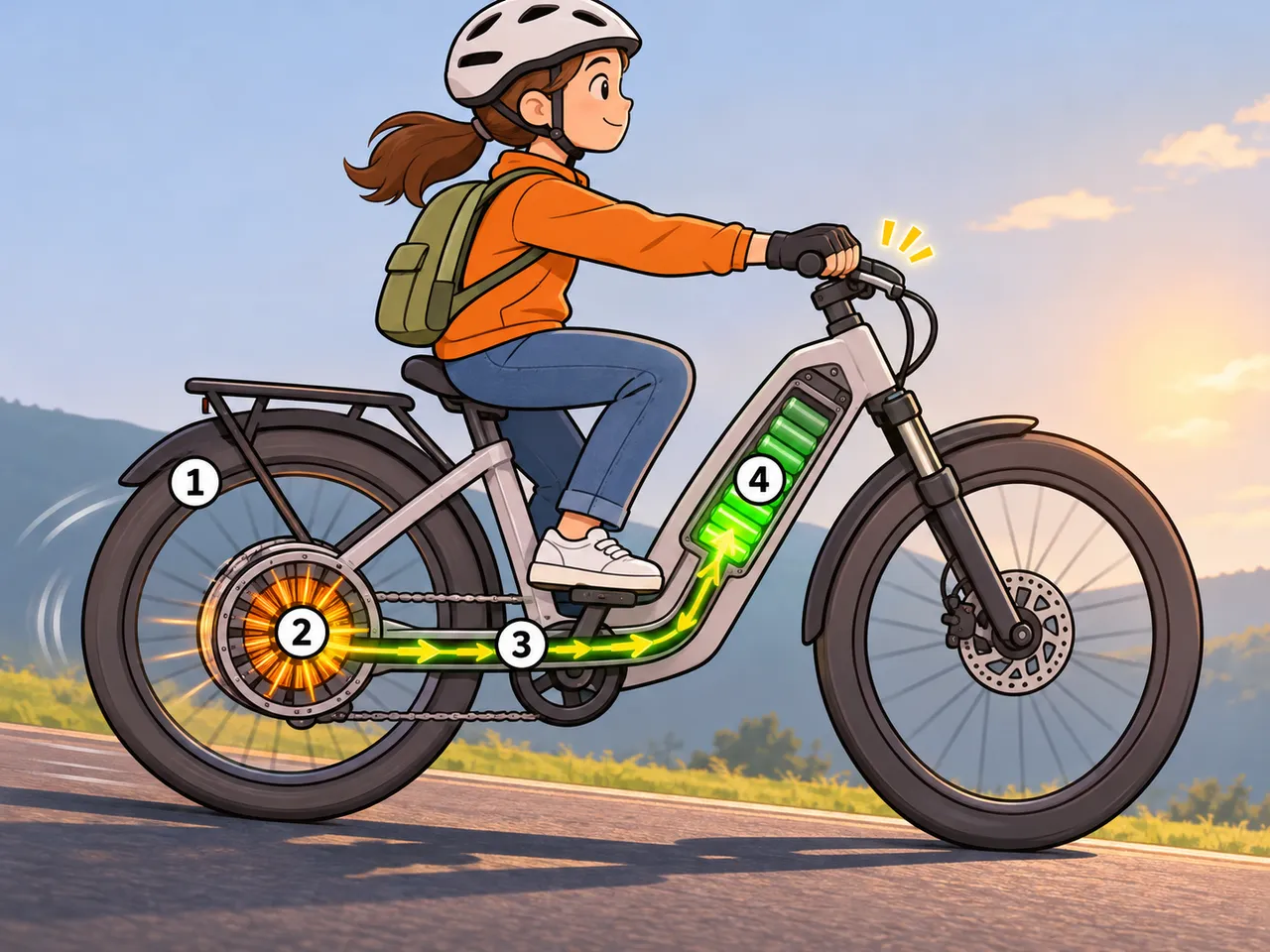
When an electric vehicle brakes, its motor can run backwards as a generator, turning the energy of motion into electricity. That electricity flows back to the battery instead of being lost as heat in the brake pads.
In the picture
- Turning wheel: the moving vehicle carries kinetic energy
- Hub motor working as a generator: it resists the wheel and converts motion into electricity
- Cable: electric current flows back from the motor towards the battery
- Battery: it stores the recovered energy as chemical energy for later
Examples
- An electric car slowing down for a red light recharges its battery a little when the driver lifts off the accelerator.
- A metro train braking as it enters a station feeds electricity back into the line for other trains to use.
Key takeaways
- An electric motor is reversible: supplied with current it produces motion, driven by motion it produces current.
- Only part of the energy is recovered, because every conversion loses some as heat.
Quiz: Regenerative braking (Age 17)
-
During regenerative braking, what does the electric motor do?
-
What does it mean to say that an electric motor is reversible?
-
Why does regenerative braking recover only part of the vehicle’s kinetic energy?
The answers, each with its explanation, are in the app. This quiz is free there while the lesson is in the free week.
Get the app
Free app, optional subscription
App Store Google Play
Carry on in the app
At least one new illustrated lesson every weekday for your child’s year, with its quiz and a reminder at 6:15 pm.
Your child’s teacher does not use My Enhanced Teacher yet?
Tell them about it