Mon Prof Augmenté
Milestones of Early Spaceflight
Open to everyone until Tuesday, September 29
To keep it, print it while it is open.
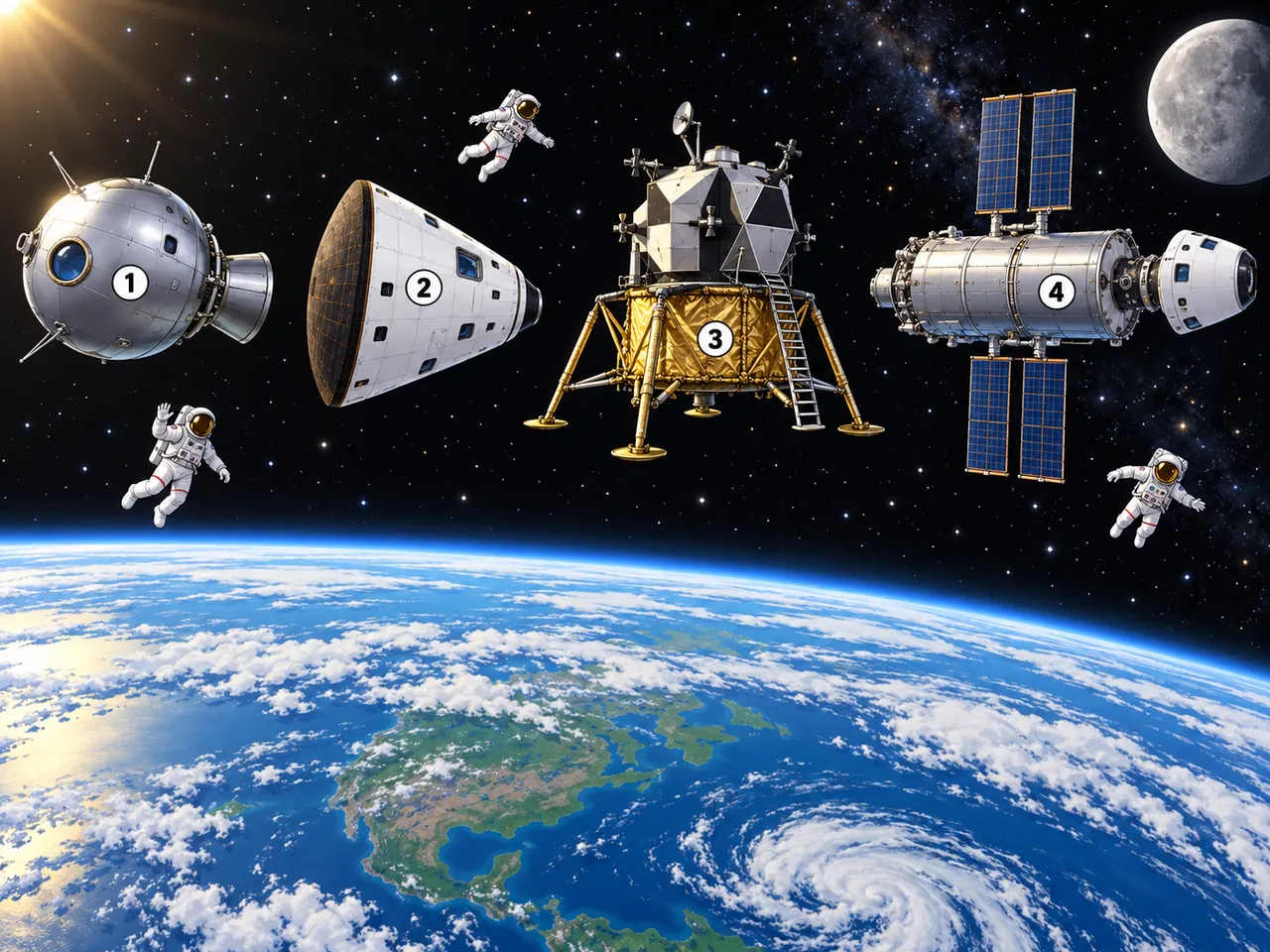
Early human spaceflight began with a single orbit of Earth and advanced through new capsules, a lunar landing, and international crews. These milestones show how spacecraft and cooperation expanded human presence beyond Earth.
In the picture
- Spherical orbital capsule: the compact cabin used for the first human orbital flight.
- Conical capsule: a crew capsule with a heat shield for returning through the atmosphere.
- Lunar lander: a two-stage craft that carried astronauts down to the Moon’s surface.
- Station module with docked crew vehicle: an orbital laboratory visited by international crews.
Examples
- A first solo trip around a city, then a coordinated journey with friends from different countries.
- Starting with a small workshop, then joining a shared research laboratory.
Key takeaways
- Human orbital flight began in 1961, and the first Moon landing took place in 1969.
- Later missions brought crews from different countries together in Earth orbit and on space stations.
Carry on in the app
Three questions on this lesson, to check the idea stuck. Free in the app while the lesson is in the free week.
At least one new illustrated lesson every weekday for your child’s year, with its quiz and a reminder at 6:15 pm.
Get the app
Free app, optional subscription
App Store Google Play