Mon Prof Augmenté
How Big Cities Pull Everything In
Age 16 · Geography
Open to everyone until Wednesday, November 18
To keep it, print it while it is open.
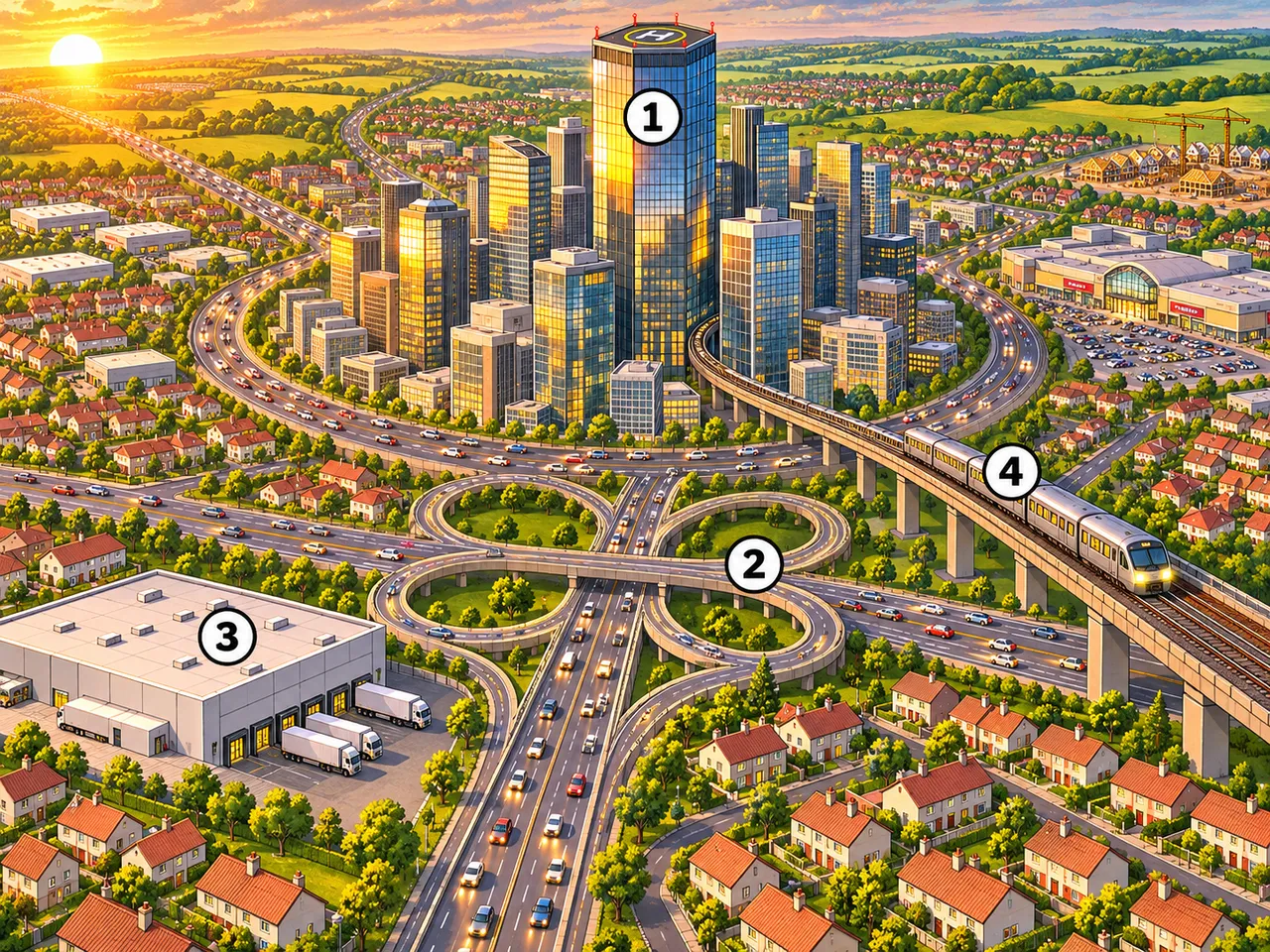
Metropolisation means that people, jobs and the power to make big decisions gather in a few huge cities. These cities spread outward into the countryside, and every day millions of people travel in from the edges to work in the centre.
In the picture
- Business district towers: company headquarters, banks and decision-makers packed together
- Ring road and interchange: motorways built to move huge numbers of people and goods
- Suburbs of houses and warehouses: the city sprawling outward over former farmland
- Commuter train: workers travelling from the periphery to the centre every day
Examples
- A parent who lives in a suburban town takes a 50-minute train every morning to an office in the city centre.
- A big international company puts its headquarters in the capital’s business district rather than in a small town.
Key takeaways
- The largest cities concentrate the best-paid jobs and the headquarters that make decisions for whole countries or the world.
- As a metropolis grows, it sprawls outward and creates long daily commutes between the periphery and the centre.
Quiz: How Big Cities Pull Everything In (Age 16)
-
According to the idea of metropolisation, what do the largest cities concentrate?
-
What happens to the land around a metropolis as it keeps growing?
-
In a metropolis, which way do millions of workers mainly travel every day?
The answers, each with its explanation, are in the app. This quiz is free there while the lesson is in the free week.
Get the app
Free app, optional subscription
App Store Google Play
Carry on in the app
At least one new illustrated lesson every weekday for your child’s year, with its quiz and a reminder at 6:15 pm.
Your child’s teacher does not use My Enhanced Teacher yet?
Tell them about it