Mon Prof Augmenté
A 19th-Century Industrial Valley
Age 16 · History

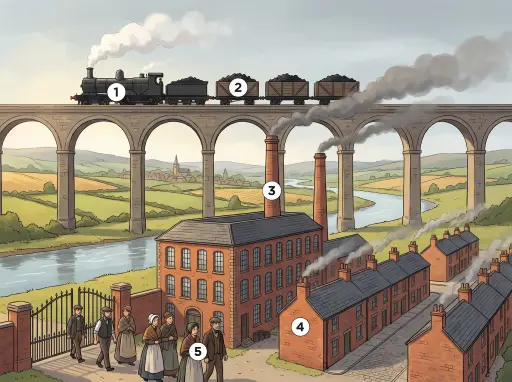
In the 1800s, steam power, railways, steel and factories changed work and travel across Europe. People left farms and villages to live in towns that grew around mills, mines and railway lines.
This picture is part of the full library
Every lesson is open to everyone for 7 days after it is published. This one came out on October 20, 2026: its text stays readable here, and its picture opens with a subscription.
The app is free. A subscription opens every lesson, in every school year.
Age 16: open this week
Browse Age 16
In the picture
- Steam locomotive boiler: where burning coal heats water into steam that drives the pistons.
- Factory chimney: carries smoke away from the coal fires that power machinery.
- Blast furnace tap hole: where molten iron, made from iron ore and coke, flows out to be cast into steel.
- Terraced workers' house: a small home built in a row for factory employees, close to the workplace.
- Horse-drawn plough: a farming tool still used on the remaining fields at the edge of the growing town.
Examples
- A heritage railway where a steam locomotive pulls passenger carriages.
- A former factory building converted into apartments or offices.
Key takeaways
- Steam engines turned coal into motion, powering trains and factory machines.
- Railways and factory jobs drew millions from farms into fast-growing cities.
Quiz: A 19th-Century Industrial Valley (Age 16)
-
According to the card, what did steam engines turn into motion?
-
What drew millions of people from farms into fast-growing cities?
-
What flowed out of the blast furnace tap hole to be cast into steel?
The answers, each with its explanation, are in the app. This lesson has left the free week, so its quiz is part of the subscription.
Free app, optional subscription
App Store Google Play
Carry on in the app
At least one new illustrated lesson every weekday for your child’s year, with its quiz and a reminder at 6:15 pm.
Your child’s teacher does not use My Enhanced Teacher yet?
Tell them about it