Mon Prof Augmenté
A lens makes a real image
Age 15 · Physics
Open to everyone until Tuesday, November 24
To keep it, print it while it is open.
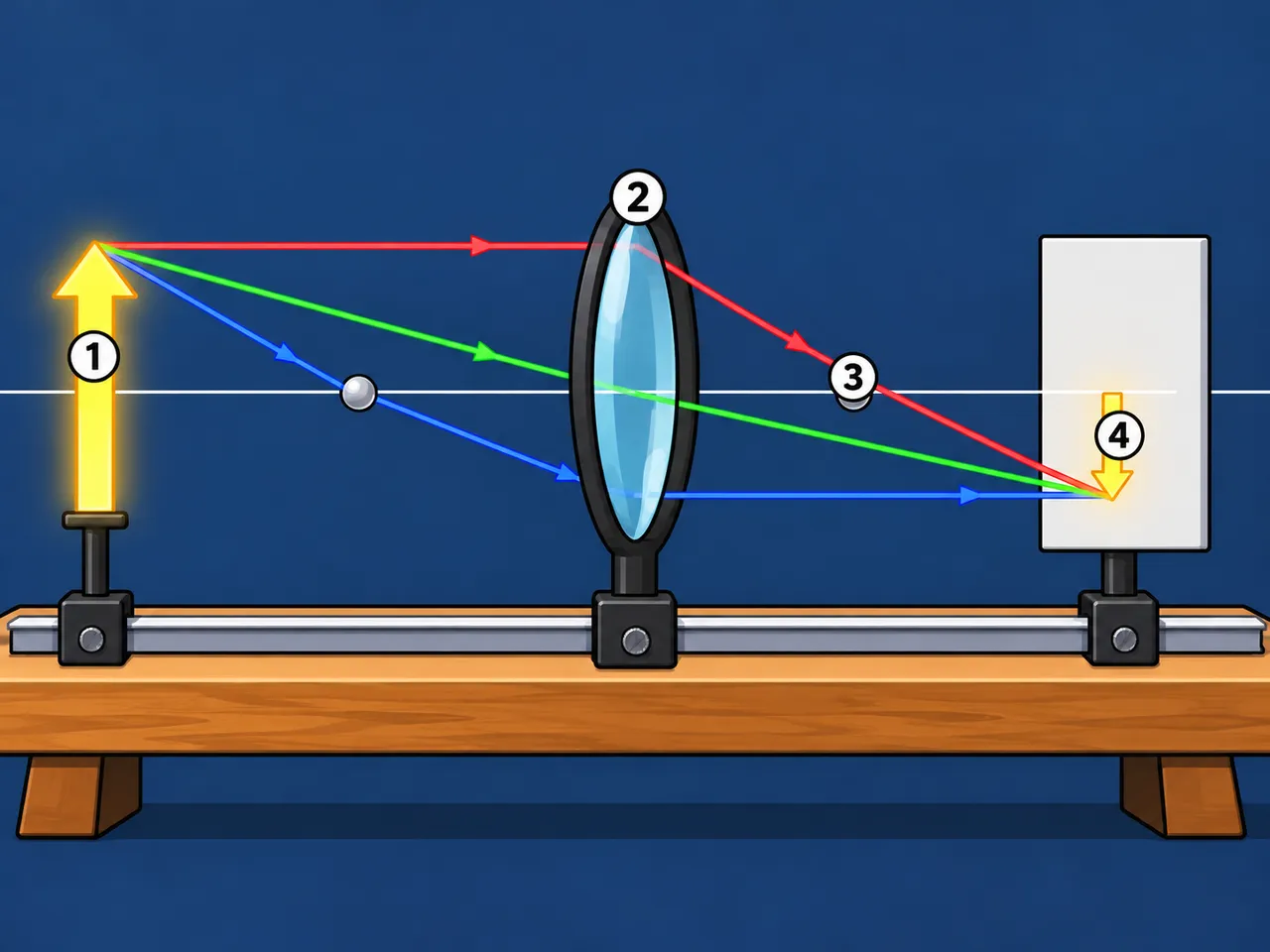
A thin converging lens bends the light rays from an object so that they meet again on the far side and form a real image on a screen. Where that image appears, how big it is and which way up it is all depend on how far the object stands from the focal point.
In the picture
- The object: a bright arrow that sends out light rays
- The converging lens: it bends every ray towards the axis
- The focal point: where rays arriving parallel to the axis cross after the lens
- The real image on the screen: smaller and upside down when the object is far away
Examples
- The lens of a camera forms a small, inverted real image of a scene on the sensor.
- A projector lens throws a real image of a slide onto a wall.
Key takeaways
- Three easy rays (parallel, through the centre, through the focus) are enough to locate the image.
- Magnification = image height ÷ object height; an object beyond twice the focal length gives a smaller, inverted image.
Quiz: A lens makes a real image (Age 15)
-
Which three rays are enough to find where a lens forms the image of an object?
-
An object stands more than twice the focal length from a converging lens. What is its real image like?
-
What is the focal point of a converging lens?
The answers, each with its explanation, are in the app. This quiz is free there while the lesson is in the free week.
Get the app
Free app, optional subscription
App Store Google Play
Carry on in the app
At least one new illustrated lesson every weekday for your child’s year, with its quiz and a reminder at 6:15 pm.
Your child’s teacher does not use My Enhanced Teacher yet?
Tell them about it