Mon Prof Augmenté
Adding two vectors
Age 15 · Maths
Open to everyone until Wednesday, November 25
To keep it, print it while it is open.
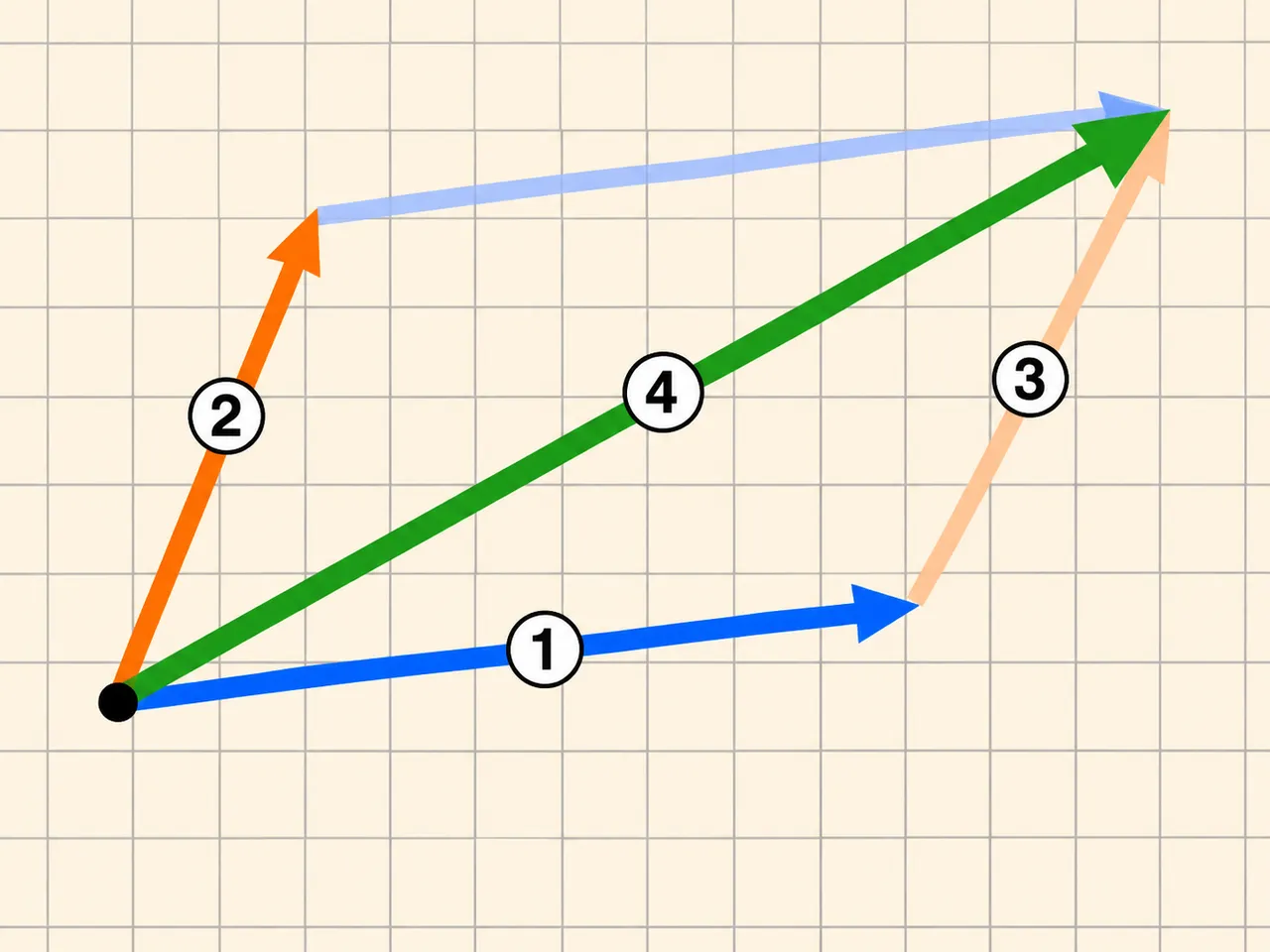
To add two vectors, place the second one at the tip of the first: the sum goes from the very start to the very end. If both start from the same point, the sum is the diagonal of the parallelogram they form.
In the picture
- First vector: a move with a direction and a length
- Second vector: another move starting from the same point
- Copy of the second vector, moved to the tip of the first: same direction, same length
- Sum vector: from the starting point to the final tip, the diagonal of the parallelogram
Examples
- A swimmer heads straight across a river while the current pushes sideways: the real path is the sum of the two movements.
- You walk 300 m east and then 400 m north: the sum is the straight arrow from where you started to where you ended, 500 m long.
Key takeaways
- Chasles relation: vector AB + vector BC = vector AC.
- The order does not matter: u + v = v + u, both give the same diagonal.
Quiz: Adding two vectors (Age 15)
-
According to the Chasles relation, what is vector AB + vector BC equal to?
-
You add two vectors u and v, then you add them in the other order, v + u. What happens to the result?
-
To add two vectors head-to-tail, you move the second vector to the tip of the first. What must stay the same when you move it?
The answers, each with its explanation, are in the app. This quiz is free there while the lesson is in the free week.
Get the app
Free app, optional subscription
App Store Google Play
Carry on in the app
At least one new illustrated lesson every weekday for your child’s year, with its quiz and a reminder at 6:15 pm.
Your child’s teacher does not use My Enhanced Teacher yet?
Tell them about it