Mon Prof Augmenté
Field Lines Tilt at Every Latitude
Earth’s magnetic field lines run almost flat along the surface near the equator and plunge steeply into it near the poles. A sea turtle that can feel this angle has a rough sense of how far north or south it is.
This picture is part of the full library
Every lesson is open to everyone for 7 days after it is published. This one came out on September 7, 2026: its text stays readable here, and its picture opens with a subscription.
The app is free. A subscription opens every lesson, in every school year.
Age 14: open this week
Browse Age 14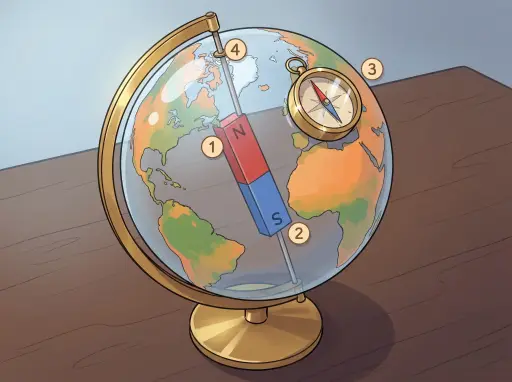

In the picture
- The curved field line arcing from pole to pole around the globe.
- The straight silver rod lying flat at the equator, side by side with the field line above it.
- The sea turtle sitting on the globe over northern Europe.
- The shaded amber wedge between the northern rod and the field line.
Examples
- A dip needle balanced on a sideways pivot: carry it further north and one end points more and more downward.
- The compass app on your phone uses a magnetic sensor that reads the field in three directions, not just left and right.
Key takeaways
- The angle between the field lines and the ground is near 0° at the magnetic equator and near 90° at the poles.
- That angle changes smoothly with latitude, so measuring it tells an animal how far north or south it is.
Carry on in the app
Three questions on this lesson. It has left the free week, so its quiz is for subscribers.
At least one new illustrated lesson every weekday for your child’s year, with its quiz and a reminder at 6:15 pm.
Get the app
Free app, optional subscription
App Store Google Play