Mon Prof Augmenté
Earth’s Moving Plates
Age 14 · Geography

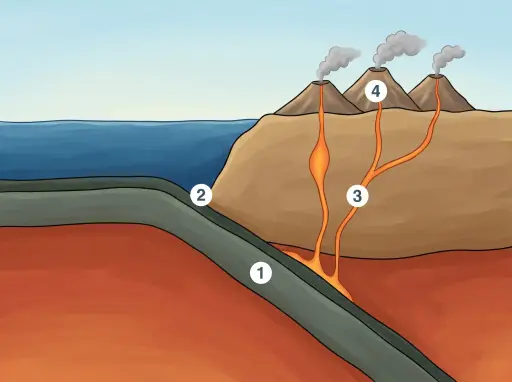
Earth’s outer rocky shell is broken into large slabs that move slowly over time. Where these slabs meet, rocks can fold into mountains, melt into volcanoes, or crack and shake.
This picture is part of the full library
Every lesson is open to everyone for 7 days after it is published. This one came out on October 4, 2026: its text stays readable here, and its picture opens with a subscription.
The app is free. A subscription opens every lesson, in every school year.
In the picture
- Thin rocky crust: the outermost layer of rock.
- Glowing mantle: hot, slowly moving rock beneath the crust.
- Colliding plate edges: two crust slabs meeting and crumpling upward into mountains.
- Volcano at a plate edge: a cone where melted rock reaches the surface.
- Fault line: a crack in the crust where rocks shift and cause earthquakes.
Examples
- A mountain range rising where two plates collide.
- An earthquake shaking a city near a plate boundary.
Key takeaways
- Earth’s crust is broken into moving plates.
- Mountains, volcanoes and earthquakes often form at plate edges.
Quiz: Earth’s Moving Plates (Age 14)
-
What is Earth’s crust broken into?
-
Where do mountains, volcanoes and earthquakes often form?
-
What happens at a fault line?
The answers, each with its explanation, are in the app. This lesson has left the free week, so its quiz is part of the subscription.
Free app, optional subscription
App Store Google Play
Carry on in the app
At least one new illustrated lesson every weekday for your child’s year, with its quiz and a reminder at 6:15 pm.
Your child’s teacher does not use My Enhanced Teacher yet?
Tell them about it