Mon Prof Augmenté
How music learned to be stored
Age 18 · Music
Open to everyone until Wednesday, November 25
To keep it, print it while it is open.
Since the late 19th century, sound has been captured on a series of carriers, from grooves in wax to magnetic tape and finally to numbers. Each new carrier made music last longer, travel more easily and copy more cheaply, changing how people listen.
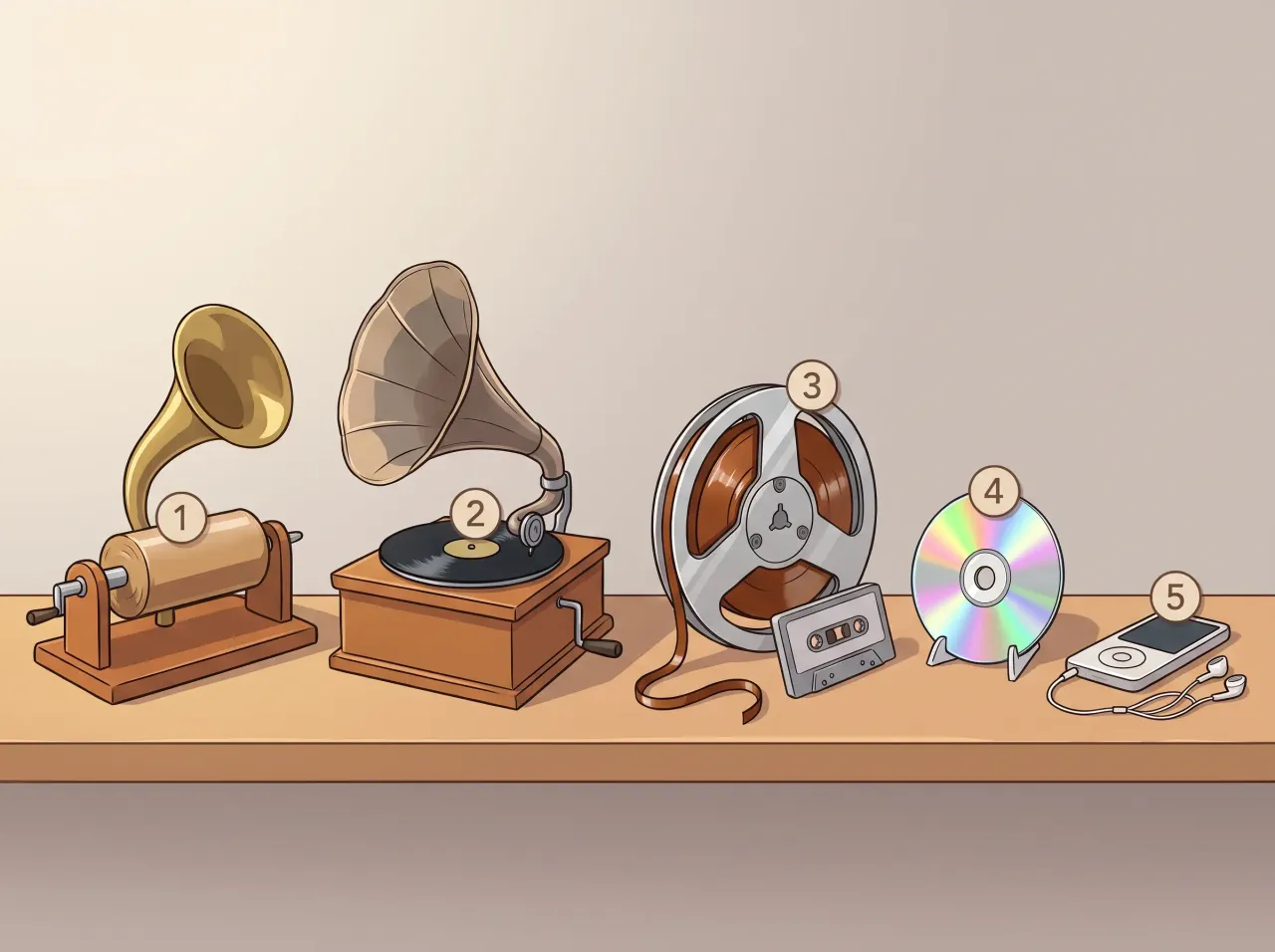
In the picture
- Wax cylinder: sound cut as a groove into wax and played back through a horn
- Disc: a spiral groove on a flat record, easy to press in thousands of copies
- Magnetic tape, on reel and in cassette: sound stored as magnetic patterns that can be erased and re-recorded
- Compact disc: sound stored as numbers and read by a laser without touching the surface
- Digital player: music kept as files in memory, with no dedicated physical carrier
Examples
- An old vinyl record crackles because a needle physically rides along its groove.
- A song streamed on a phone is a digital file sent from a distant server.
Key takeaways
- Cylinders, discs and tapes are analogue: they hold a continuous trace of the sound wave, while CDs and files hold it as numbers.
- Every new carrier changed listening habits by making music more durable, portable and easy to copy.
Quiz: How music learned to be stored (Age 18)
-
What separates analogue carriers from digital ones in the way they hold sound?
-
Which carrier stores sound as patterns that can be erased and recorded over again?
-
How is the sound on a compact disc read?
The answers, each with its explanation, are in the app. This quiz is free there while the lesson is in the free week.
Get the app
Free app, optional subscription
App Store Google Play
Carry on in the app
At least one new illustrated lesson every weekday for your child’s year, with its quiz and a reminder at 6:15 pm.
Your child’s teacher does not use My Enhanced Teacher yet?
Tell them about it