Mon Prof Augmenté
Young’s double-slit interference
Age 18 · Science
Open to everyone until Tuesday, November 24
To keep it, print it while it is open.
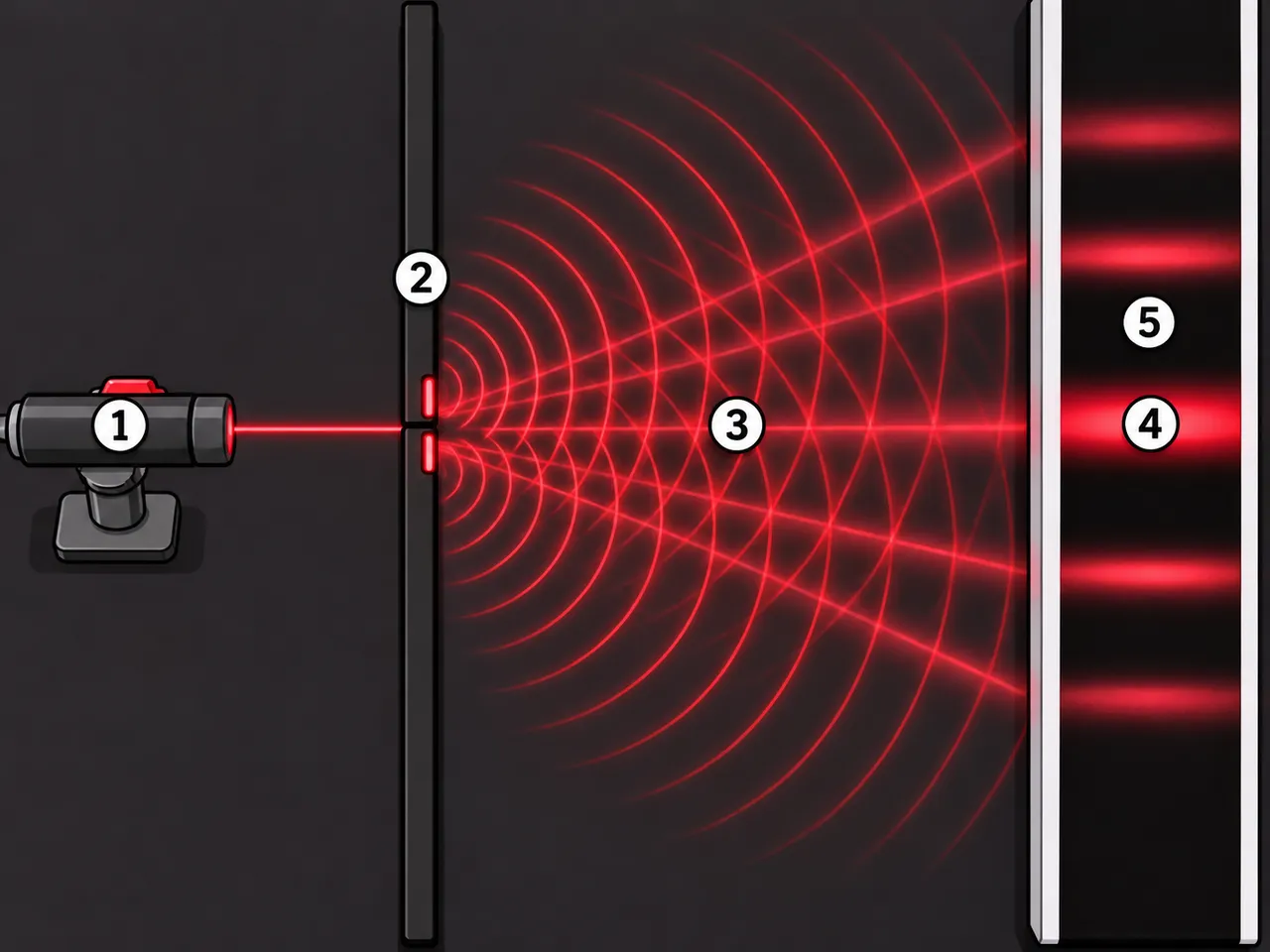
When light of a single wavelength passes through two narrow slits, the two emerging waves overlap and combine. Where they arrive in step they reinforce into bright fringes, and where they arrive half a wavelength out of step they cancel into dark fringes.
In the picture
- Laser: a source of light with a single wavelength
- Double slit: each slit acts as a source of waves in step with the other
- Overlap region: the two waves superpose
- Bright fringe: path difference is a whole number of wavelengths, so the waves reinforce
- Dark fringe: path difference is a half-odd number of wavelengths, so the waves cancel
Examples
- Shining a laser pointer through two fine scratches in a painted glass slide produces a row of bright dots on the wall.
- Two sets of ripples spreading from two pebbles dropped in a pond make calm lines and choppy lines where they cross.
Key takeaways
- Fringe spacing is wavelength × screen distance ÷ slit separation.
- Interference fringes are evidence that light behaves as a wave.
Quiz: Young’s double-slit interference (Age 18)
-
At one point on the screen, the light from one slit has travelled one and a half wavelengths further than the light from the other slit. What appears there?
-
The two slits are moved closer together, while the light and the distance to the screen stay the same. What happens to the fringe spacing?
-
What do the interference fringes tell us about the nature of light?
The answers, each with its explanation, are in the app. This quiz is free there while the lesson is in the free week.
Get the app
Free app, optional subscription
App Store Google Play
Carry on in the app
At least one new illustrated lesson every weekday for your child’s year, with its quiz and a reminder at 6:15 pm.
Your child’s teacher does not use My Enhanced Teacher yet?
Tell them about it