Mon Prof Augmenté
The dominant seventh chord G7
Age 18 · Music

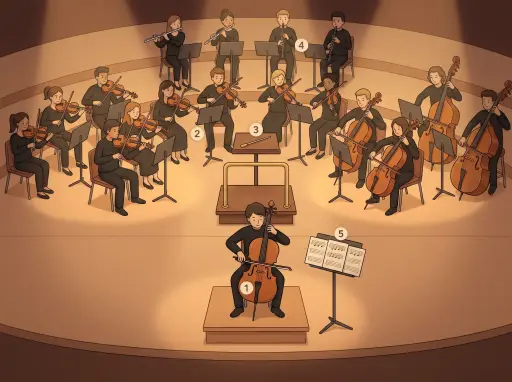
A dominant seventh chord stacks a major third, a perfect fifth and a minor seventh on a root, like G, B, D and F. Its built-in tension makes the ear expect the tonic chord, here C major, to come next.
This picture is part of the full library
Every lesson is open to everyone for 7 days after it is published. This one came out on November 2, 2026: its text stays readable here, and its picture opens with a subscription.
The app is free. A subscription opens every lesson, in every school year.
In the picture
- G, the root: the note the chord is built on, the fifth degree of C major
- B, the major third: four semitones above G, it pulls up to C
- D, the perfect fifth: seven semitones above G, it makes the chord stable
- F, the minor seventh: ten semitones above G, it pulls down to E
- C major, the tonic chord: where the tension of G7 resolves
Examples
- In "Happy Birthday" played in C, a G7 chord usually sits under the final "to", and C major arrives on "you".
- A guitarist strums E7 just before the last A chord of a song, and listeners can hear that the song is ending.
Key takeaways
- Dominant seventh = root + major third + perfect fifth + minor seventh (4 + 3 + 3 semitones).
- Built on the fifth degree (V7), it resolves to the tonic chord (I): the third rises and the seventh falls.
Quiz: The dominant seventh chord G7 (Age 18)
-
Which set of intervals, stacked on a root, makes a dominant seventh chord?
-
In C major, which chord does the ear expect to hear after G7, the chord built on G?
-
When G7 resolves to C major, what do its third (B) and its seventh (F) do?
The answers, each with its explanation, are in the app. This lesson has left the free week, so its quiz is part of the subscription.
Free app, optional subscription
App Store Google Play
Carry on in the app
At least one new illustrated lesson every weekday for your child’s year, with its quiz and a reminder at 6:15 pm.
Your child’s teacher does not use My Enhanced Teacher yet?
Tell them about it