Mon Prof Augmenté
Acid-Base Titration Colour Change
Age 18 · Chemistry

In an acid-base titration, a burette delivers one solution into a flask until an indicator changes colour. The volume used at that colour change lets you calculate the unknown concentration.
This picture is part of the full library
Every lesson is open to everyone for 7 days after it is published. This one came out on October 12, 2026: its text stays readable here, and its picture opens with a subscription.
The app is free. A subscription opens every lesson, in every school year.


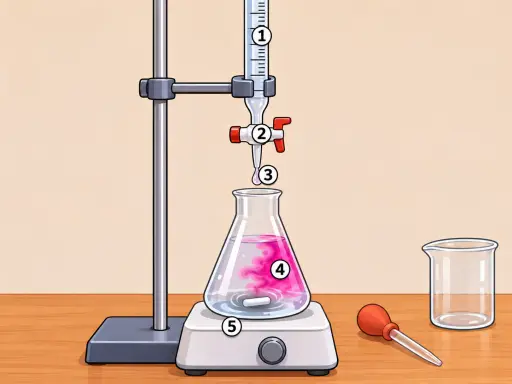
In the picture
- Burette scale at the meniscus: the volume of solution delivered
- Stopcock: controls the flow of solution from the burette
- Conical flask with pale pink liquid: the indicator has changed colour
- White tile: provides a clear background for judging the colour
Examples
- Using phenolphthalein to find the concentration of vinegar by titrating it with sodium hydroxide.
- Checking the acidity of a fruit juice sample by adding a base until the indicator turns pink.
Key takeaways
- The indicator colour change marks the end point, which is chosen to be very close to the equivalence point.
- The volume of titrant added, together with its known concentration and the reaction stoichiometry, gives the unknown concentration.
Quiz: Acid-Base Titration Colour Change (Age 18)
-
During an acid-base titration, what does the indicator colour change indicate?
-
In a titration calculation, what must be used together with the volume of titrant added to find the unknown concentration?
-
What is the function of the stopcock in the titration setup?
The answers, each with its explanation, are in the app. This lesson has left the free week, so its quiz is part of the subscription.
Free app, optional subscription
App Store Google Play
Carry on in the app
At least one new illustrated lesson every weekday for your child’s year, with its quiz and a reminder at 6:15 pm.
Your child’s teacher does not use My Enhanced Teacher yet?
Tell them about it