Mon Prof Augmenté
From a lion down to one cell
Age 15 · Biology
Open to everyone until Sunday, November 29
To keep it, print it while it is open.
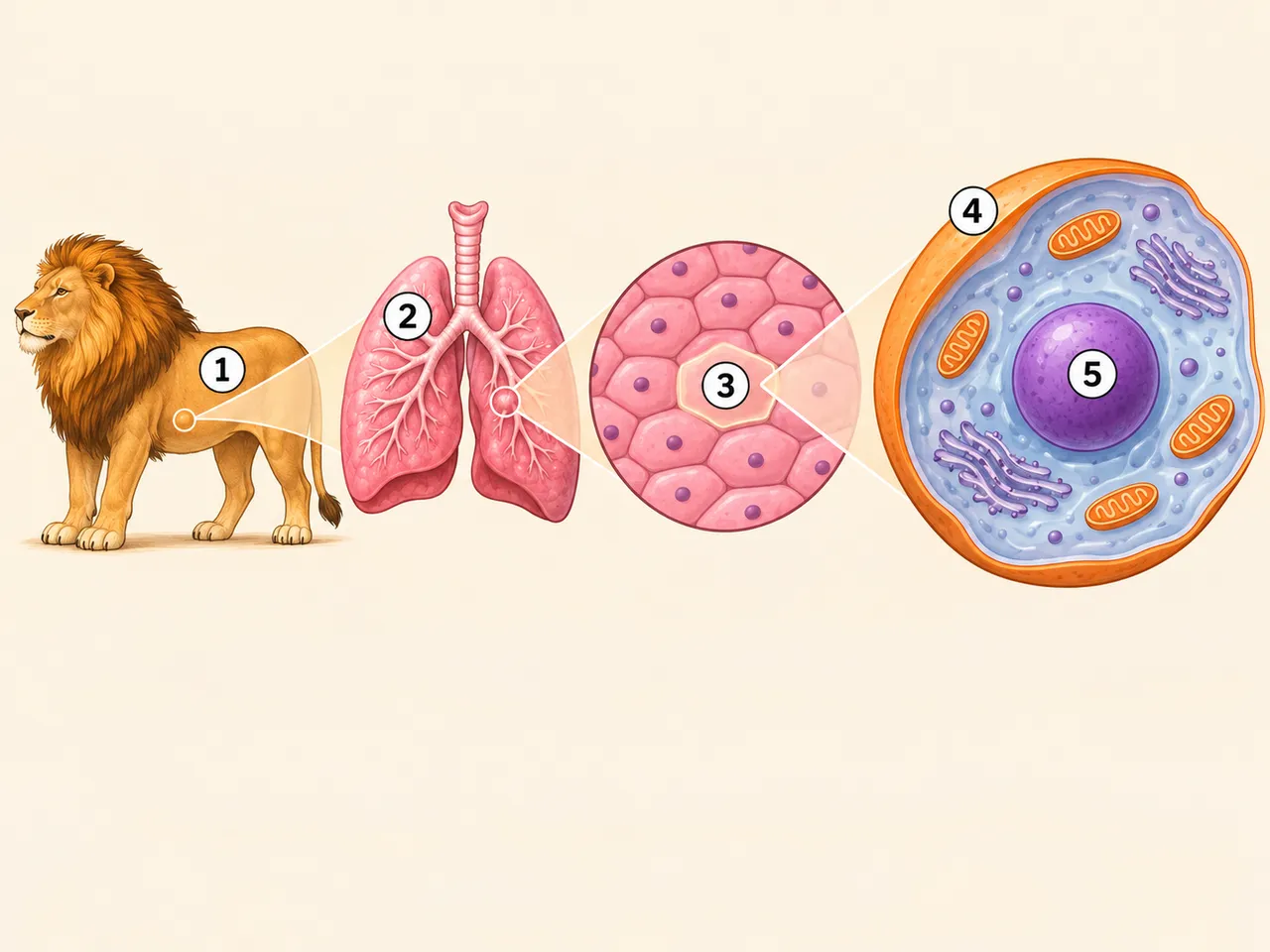
Every living thing is made of cells, and each cell has a membrane, cytoplasm and usually a nucleus. In a large organism, similar specialised cells form tissues, and several tissues work together to build an organ.
In the picture
- The lion: a multicellular organism made of billions of cells
- The lung: an organ built from several tissues working together
- Lung lining tissue: many similar specialised cells packed side by side
- Cell membrane and the cytoplasm it encloses: the membrane controls what enters and leaves, the jelly-like cytoplasm is where the cell’s chemical reactions happen
- Nucleus: holds the DNA that directs the cell’s activity
Examples
- Your skin is an organ: it contains tissues such as the epidermis, made of flat cells packed tightly to protect you.
- A thin slice of onion skin under a school microscope shows rows of cells, each with a visible nucleus.
Key takeaways
- The cell is the smallest unit of life: membrane outside, cytoplasm inside, nucleus holding the DNA.
- Levels of organisation: cell → tissue → organ → organism.
Quiz: From a lion down to one cell (Age 15)
-
Which part of a cell controls what enters and leaves it?
-
Which sequence goes from the smallest level of organisation to the largest?
-
What does the nucleus of a cell do?
The answers, each with its explanation, are in the app. This quiz is free there while the lesson is in the free week.
Get the app
Free app, optional subscription
App Store Google Play
Carry on in the app
At least one new illustrated lesson every weekday for your child’s year, with its quiz and a reminder at 6:15 pm.
Your child’s teacher does not use My Enhanced Teacher yet?
Tell them about it