Mon Prof Augmenté
How a snail builds its shell
Age 14 · Biology
Open to everyone until Thursday, November 12
To keep it, print it while it is open.
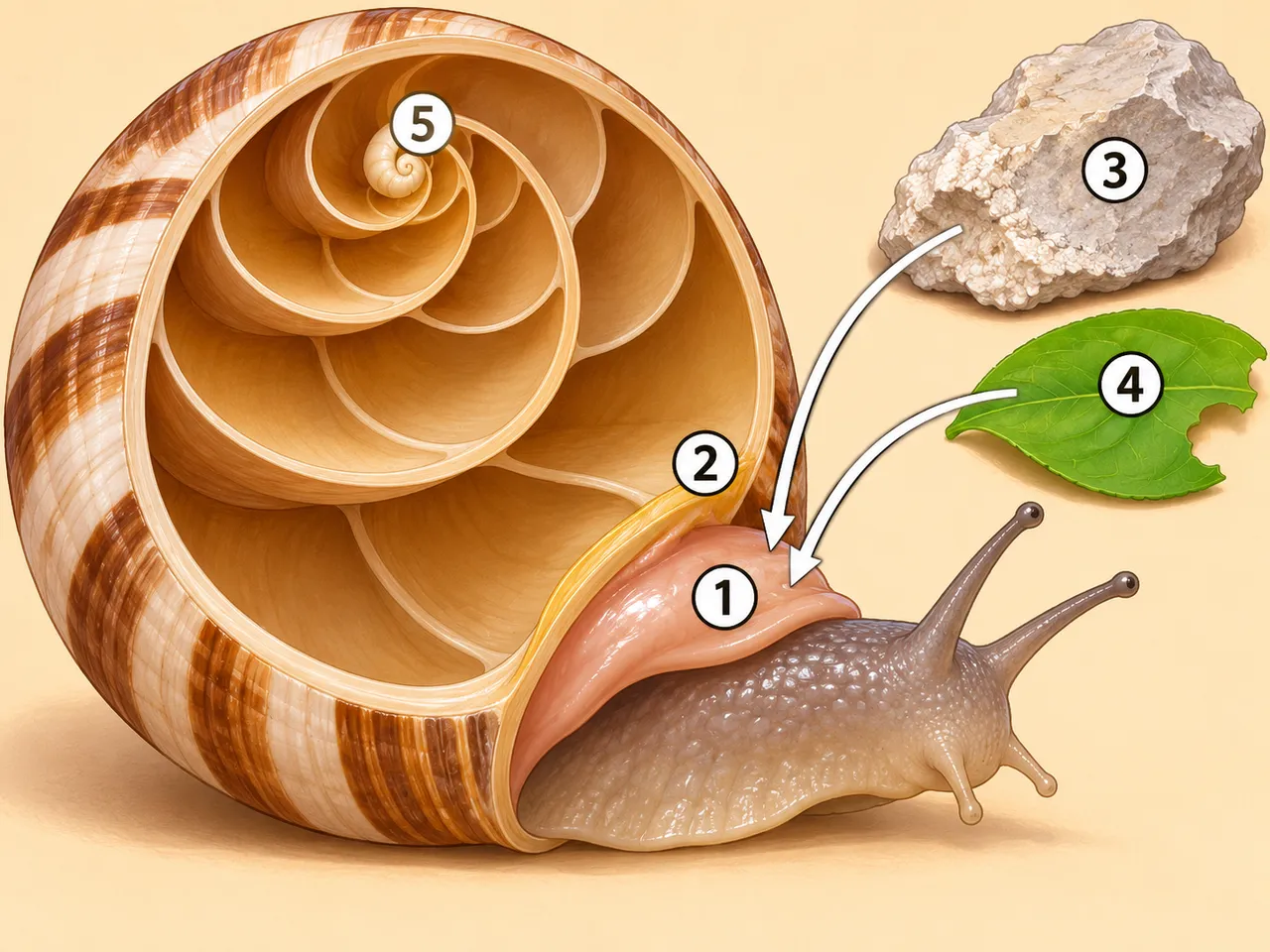
A snail’s mantle, the soft tissue at the shell opening, makes a thin flexible layer of organic material. It then hardens that layer with calcium carbonate taken from food and limestone, adding new spiral growth at the rim.
In the picture
- Mantle edge: the tissue that secretes the shell material
- New thin ring: a flexible organic layer, not yet hardened
- Limestone: a source of calcium carbonate
- Leaf: food that also supplies calcium
- Apex: the hatchling’s first tiny shell, the oldest part of the spiral
Examples
- A garden snail nibbling chalky stone or eggshell to get calcium
- A snail shell with a thin, fragile lip at the edge while the animal is still growing
Key takeaways
- The mantle makes the shell: first a flexible organic layer, then calcium carbonate hardens it.
- The shell grows at the rim, so the oldest part is at the spiral’s tip.
Quiz: How a snail builds its shell (Age 14)
-
How does a snail make new shell material?
-
Because a snail’s shell grows at the rim, where is the oldest part of the shell?
-
Where does a snail get the calcium carbonate that hardens its shell?
The answers, each with its explanation, are in the app. This quiz is free there while the lesson is in the free week.
Get the app
Free app, optional subscription
App Store Google Play
Carry on in the app
At least one new illustrated lesson every weekday for your child’s year, with its quiz and a reminder at 6:15 pm.
Your child’s teacher does not use My Enhanced Teacher yet?
Tell them about it