Mon Prof Augmenté
Series and parallel circuits
Age 12 · Physics
Open to everyone until Monday, October 26
To keep it, print it while it is open.
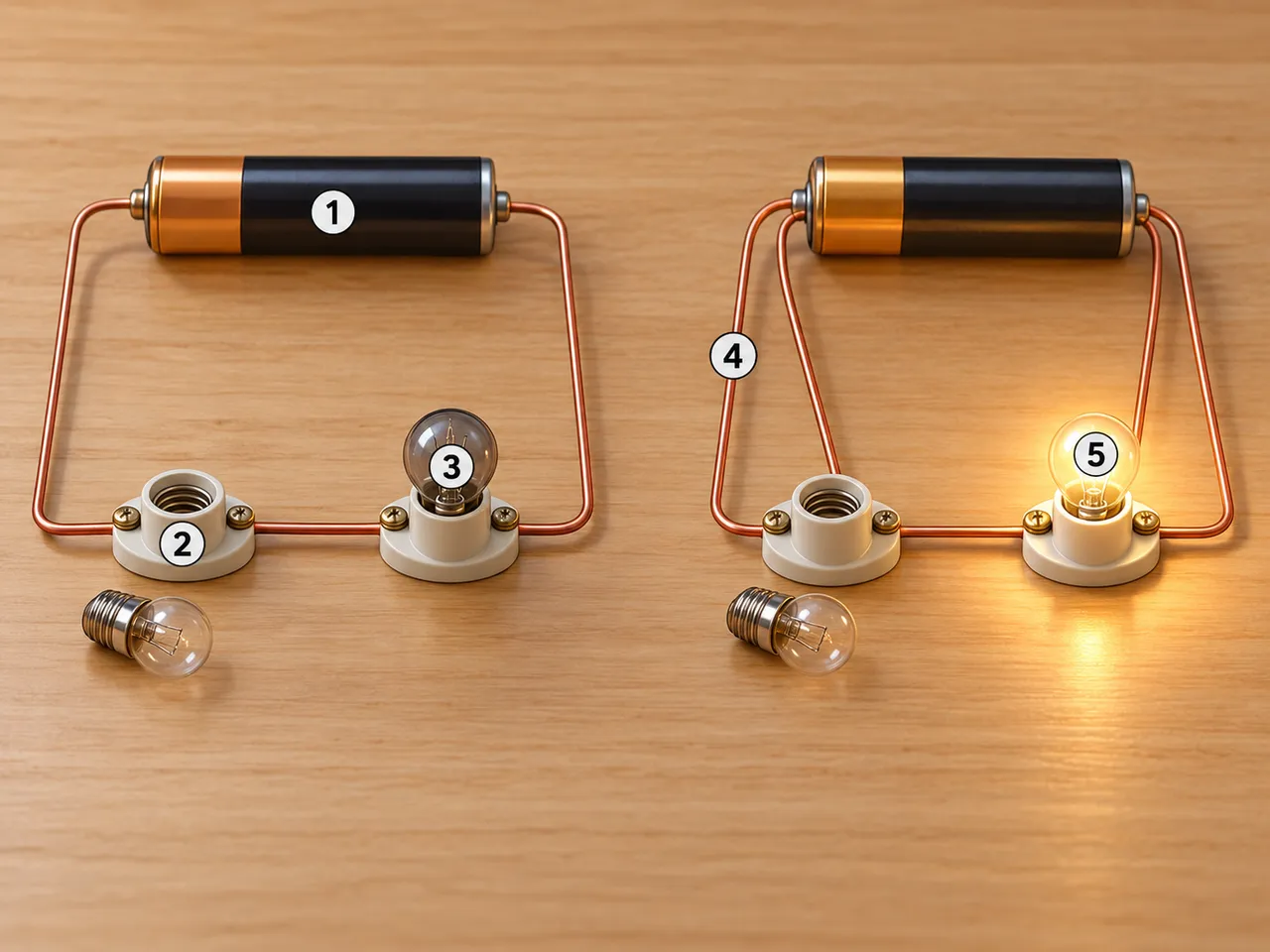
In a series circuit, the bulbs sit on one shared loop, so removing one bulb stops the current. In a parallel circuit, each bulb has its own branch to the battery, so another bulb can stay lit.
In the picture
- Battery in the series circuit: pushes charge through the one shared loop
- Empty bulb holder in the series circuit: opens the only path
- Dark bulb in the series circuit: receives no current because the path is broken
- Left branch wire in the parallel circuit: gives one bulb its own path to the battery
- Glowing bulb on its own branch: stays lit while the other branch is open
Examples
- A cheap string of fairy lights goes dark when one bulb is removed.
- Many household ceiling lights stay on when a bulb in another room is removed.
Key takeaways
- A series circuit has one shared path for all bulbs.
- Separate branches give each bulb its own path.
Quiz: Series and parallel circuits (Age 12)
-
In a series circuit, what path do the bulbs use?
-
In a parallel circuit, what does each bulb have?
-
What happens in a series circuit when one bulb is removed?
The answers, each with its explanation, are in the app. This quiz is free there while the lesson is in the free week.
Get the app
Free app, optional subscription
App Store Google Play
Carry on in the app
At least one new illustrated lesson every weekday for your child’s year, with its quiz and a reminder at 6:15 pm.
Your child’s teacher does not use My Enhanced Teacher yet?
Tell them about it