Mon Prof Augmenté
Still Frames, Moving Ball
Age 12 · Biology
Your eye holds each picture for a tiny moment after it appears. When new pictures arrive quickly, the old and new images blend into one smooth motion.
This picture is part of the full library
Every lesson is open to everyone for 7 days after it is published. This one came out on October 2, 2026: its text stays readable here, and its picture opens with a subscription.
The app is free. A subscription opens every lesson, in every school year.
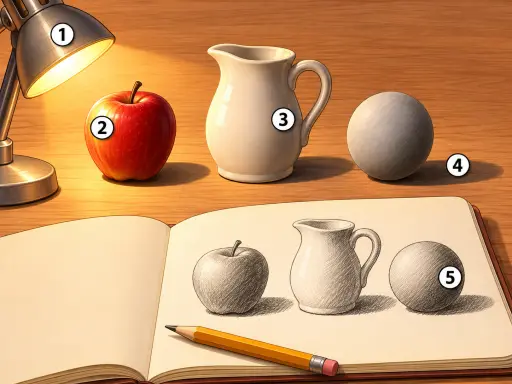

In the picture
- Retina: the back surface of the eye where each image lingers for a moment.
- Frame strip: separate still pictures, each with the ball in a slightly different position.
- Current ball image: the newest picture that has just reached the eye.
- Previous ball image: the faint earlier picture still overlapping the new one.
Examples
- A flipbook makes a drawn figure move when you flip the pages quickly.
- A movie or cartoon is a series of still pictures shown fast enough to look continuous.
Key takeaways
- The eye keeps each image for a very short time after it is gone.
- The brain joins quick, separate images into the feeling of smooth movement.
Quiz: Still Frames, Moving Ball (Age 12)
-
Why does a fast series of still pictures look like smooth movement?
-
What happens to an image in the eye right after it is gone?
-
What does the brain do with quick, separate images?
The answers, each with its explanation, are in the app. This lesson has left the free week, so its quiz is part of the subscription.
Free app, optional subscription
App Store Google Play
Carry on in the app
At least one new illustrated lesson every weekday for your child’s year, with its quiz and a reminder at 6:15 pm.
Your child’s teacher does not use My Enhanced Teacher yet?
Tell them about it