Mon Prof Augmenté
The Four Families of the Orchestra
Age 10 · Music
Open to everyone until Thursday, October 29
To keep it, print it while it is open.
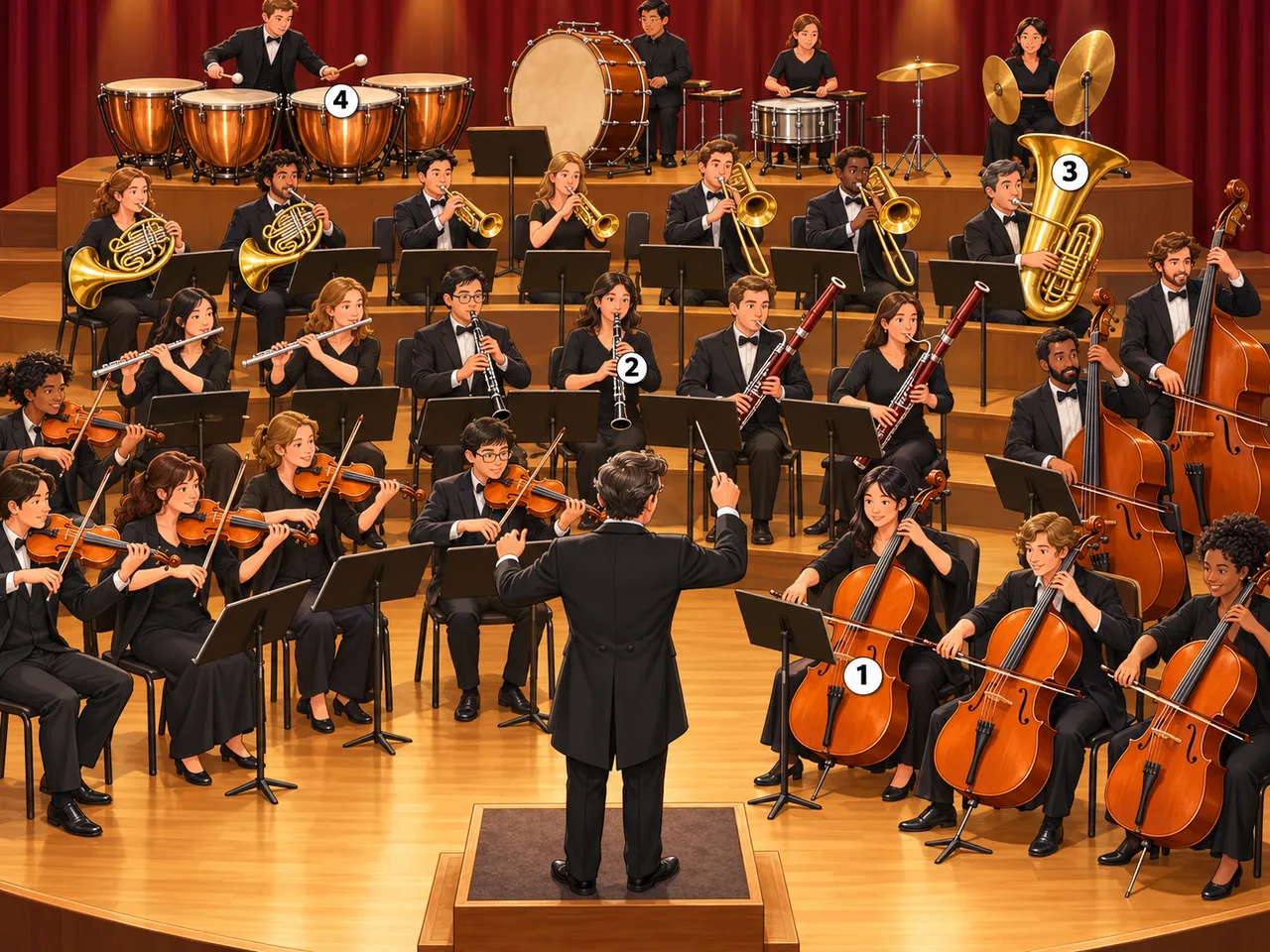
A symphony orchestra is made of four families of instruments: strings, woodwinds, brass and percussion. The quieter strings sit at the front near the conductor, and the louder brass and percussion sit at the back.
In the picture
- Strings: violins, violas, cellos and double basses, in the front arc
- Woodwinds: flutes, oboes, clarinets and bassoons, in the middle
- Brass: horns, trumpets, trombones and tuba, behind the woodwinds
- Percussion: timpani, drums and cymbals, at the very back
Examples
- At a school concert, the violins usually sit closest to the audience.
- In a film soundtrack, a crash of cymbals or a boom of timpani comes from the back of the orchestra.
Key takeaways
- An orchestra has four instrument families: strings, woodwinds, brass and percussion.
- The loudest instruments sit at the back so they don’t drown out the quieter ones.
Quiz: The Four Families of the Orchestra (Age 10)
-
An orchestra is made of four instrument families. Which list names them?
-
Why do the loudest instruments sit at the back of the orchestra?
-
Which instrument family sits at the front, closest to the conductor?
The answers, each with its explanation, are in the app. This quiz is free there while the lesson is in the free week.
Get the app
Free app, optional subscription
App Store Google Play
Carry on in the app
At least one new illustrated lesson every weekday for your child’s year, with its quiz and a reminder at 6:15 pm.
Your child’s teacher does not use My Enhanced Teacher yet?
Tell them about it