Mon Prof Augmenté
Two slits make light bands
Age 18 · Physics
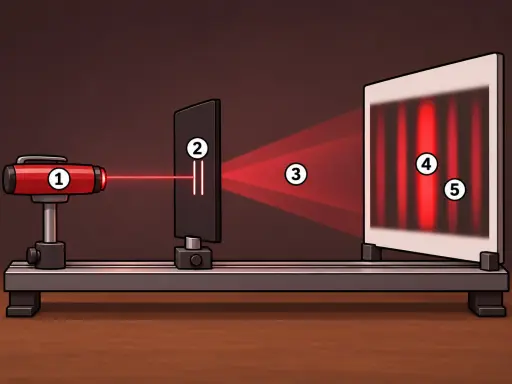
Green laser light passes through two narrow slits and lands on a screen as alternating bright and dark vertical bands. The bright bands appear where waves from the slits arrive together, and dark bands where they arrive out of step.
This picture is part of the full library
Every lesson is open to everyone for 7 days after it is published. This one came out on October 8, 2026: its text stays readable here, and its picture opens with a subscription.
The app is free. A subscription opens every lesson, in every school year.
In the picture
- Laser source: sends a narrow green beam toward the slits.
- Barrier with two thin slits: lets the beam become two overlapping sets of waves.
- Central bright band: waves from both slits arrive in step.
- Dark band: waves from the two slits arrive half a wavelength out of step.
- Crossing arcs: two wavefronts meet; their step relation changes from one place to the next.
Examples
- Colourful reflections on a soap bubble.
- The shimmering colours on a CD or DVD surface.
Key takeaways
- Bright bands occur when the path difference is a whole number of wavelengths.
- Dark bands occur when the path difference is half a wavelength.
Quiz: Two slits make light bands (Age 18)
-
In a double-slit pattern, what path difference makes a bright band?
-
In a double-slit pattern, what path difference makes a dark band?
-
Why are there alternating bright and dark bands on the screen?
The answers, each with its explanation, are in the app. This lesson has left the free week, so its quiz is part of the subscription.
Free app, optional subscription
App Store Google Play
Carry on in the app
At least one new illustrated lesson every weekday for your child’s year, with its quiz and a reminder at 6:15 pm.
Your child’s teacher does not use My Enhanced Teacher yet?
Tell them about it