Mon Prof Augmenté
Light fringes from two slits
Age 18 · Physics
Open to everyone until Sunday, November 15
To keep it, print it while it is open.
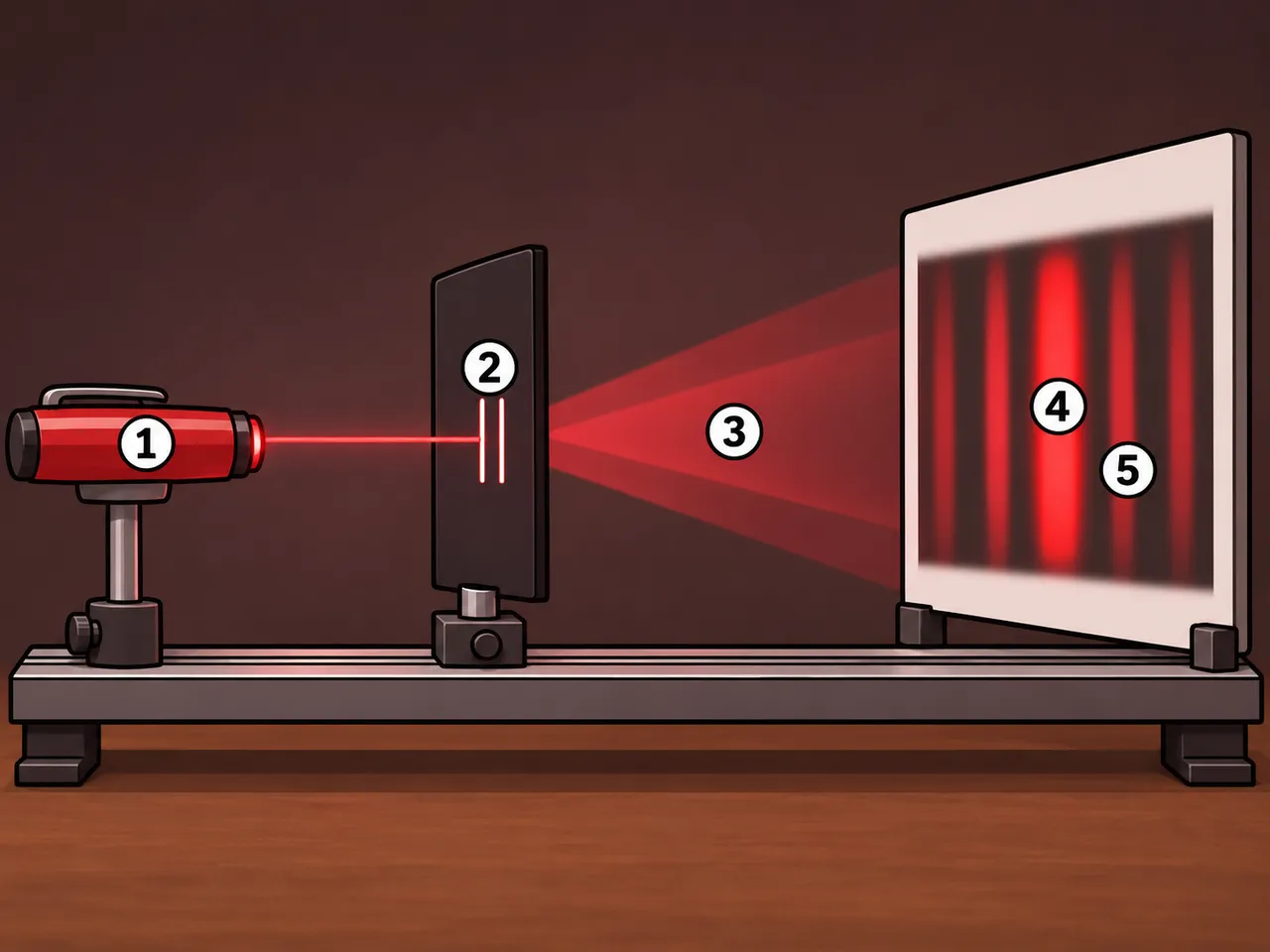
When one colour of light passes through two very narrow, close slits, the two waves spread out and overlap. On a screen they add up in some places and cancel in others, giving evenly spaced bright and dark stripes.
In the picture
- Laser: a source of single-colour (monochromatic) light
- Double slit: two narrow openings that split the beam into two waves
- Overlapping waves: the two spreading waves meet and combine
- Central bright band: the waves arrive in step and reinforce, giving the brightest fringe
- Dark gap: the waves arrive out of step and cancel each other
Examples
- Rainbow colours on the surface of a CD or soap bubble
- Colour patterns seen when looking at a streetlight through a fine fabric
Key takeaways
- Bright fringes appear where waves reinforce; dark fringes where they cancel.
- The fringe pattern is evidence that light behaves as a wave.
Quiz: Light fringes from two slits (Age 18)
-
At a bright fringe on the screen, how do the waves from the two slits arrive?
-
What does the pattern of bright and dark fringes tell us about light?
-
What is the job of the double slit in the experiment?
The answers, each with its explanation, are in the app. This quiz is free there while the lesson is in the free week.
Get the app
Free app, optional subscription
App Store Google Play
Carry on in the app
At least one new illustrated lesson every weekday for your child’s year, with its quiz and a reminder at 6:15 pm.
Your child’s teacher does not use My Enhanced Teacher yet?
Tell them about it