Mon Prof Augmenté
From power station to your socket
Age 17 · Daily Life
Open to everyone until Friday, November 13
To keep it, print it while it is open.
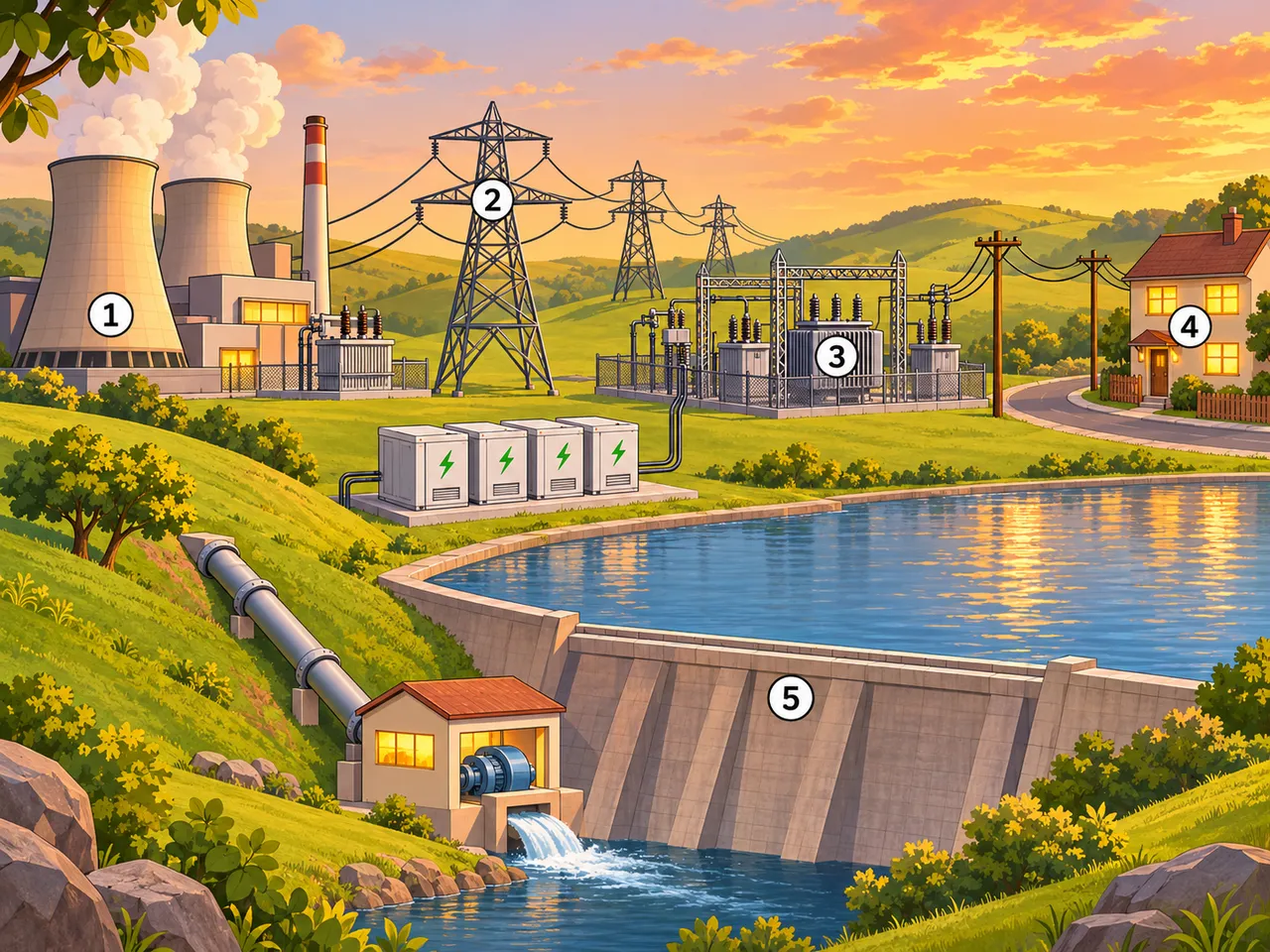
Electricity is generated at a power station, sent at very high voltage over long lines, then stepped down until it is safe for homes. Because supply and demand must match at every moment, grids use storage such as water reservoirs and batteries to absorb surplus and release it later.
In the picture
- Power station: generates electricity and feeds it into the grid through a step-up transformer
- Pylon with high-voltage lines: carries power over long distances with low losses
- Substation transformer: lowers the voltage for local distribution
- House: the consumer, whose demand rises and falls through the day
- Pumped-storage reservoir: stores surplus energy as water held uphill, ready to release when demand rises
Examples
- In the evening everyone cooks and switches on lights, so demand peaks and stored water or batteries add power to the grid.
- On a sunny, windy afternoon with little demand, surplus solar and wind power can pump water uphill or charge batteries.
Key takeaways
- A grid must balance supply and demand at every second, or its frequency drifts.
- Storage turns a flow of electricity into a stock of energy, such as water uphill or charge in a battery, to use later.
Quiz: From power station to your socket (Age 17)
-
What happens to an electricity grid if supply and demand are not matched at every moment?
-
Why is electricity sent over long distances at very high voltage?
-
In a pumped-storage reservoir, in what form is surplus energy kept for later?
The answers, each with its explanation, are in the app. This quiz is free there while the lesson is in the free week.
Get the app
Free app, optional subscription
App Store Google Play
Carry on in the app
At least one new illustrated lesson every weekday for your child’s year, with its quiz and a reminder at 6:15 pm.
Your child’s teacher does not use My Enhanced Teacher yet?
Tell them about it