Mon Prof Augmenté
Our branching family tree
Age 17 · Biology
Open to everyone until Thursday, November 12
To keep it, print it while it is open.
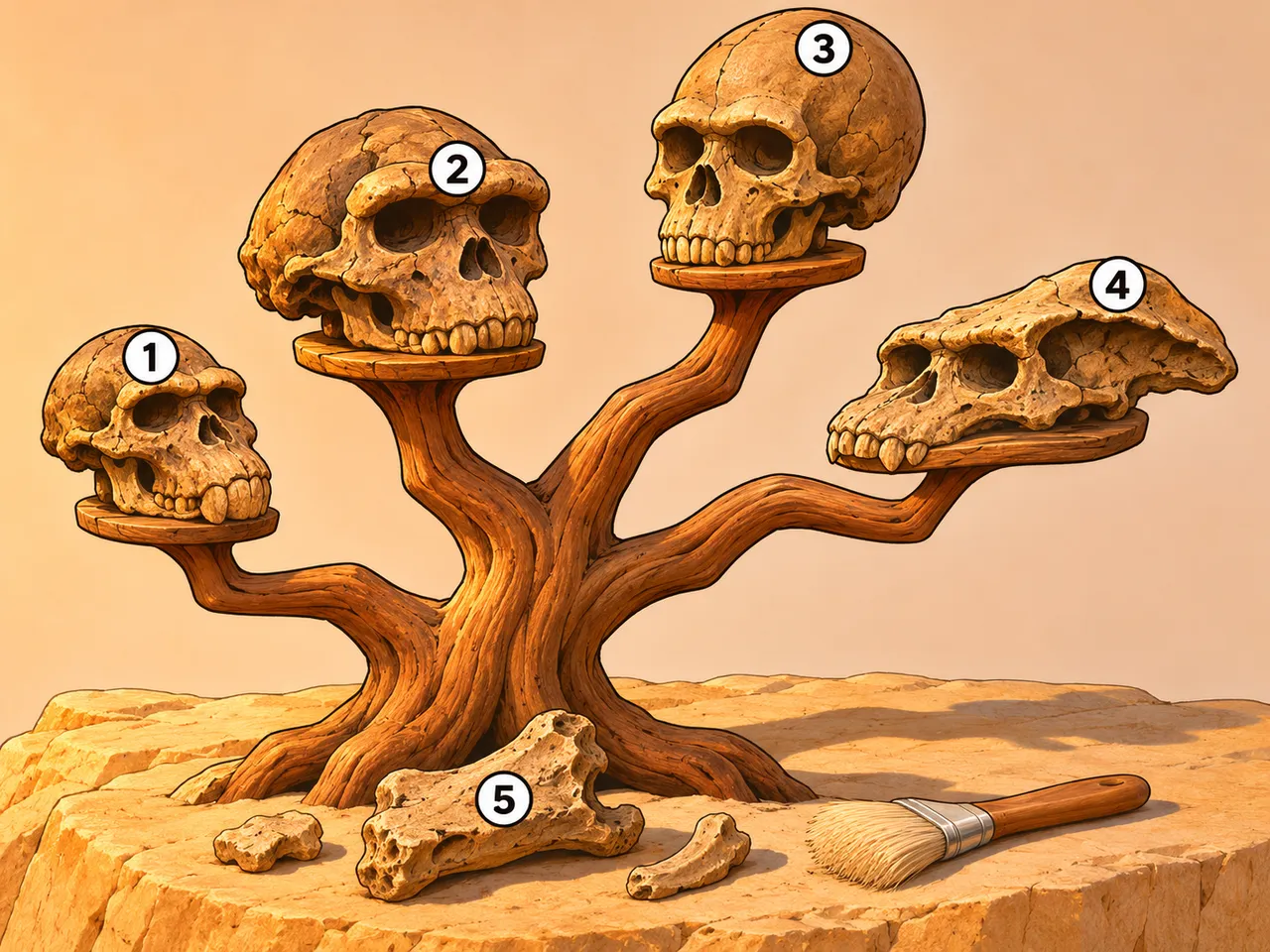
Palaeoanthropologists rebuild human origins from fossils such as skulls and bones. These finds show that hominins formed a branching family with many side lines, not a single straight line.
In the picture
- Small braincase and projecting jaw: an early hominin
- Thicker brow and larger braincase: a later relative
- Tall rounded braincase and flatter face: closer to modern humans
- Heavy crest on a side limb: a branch that left no descendants
- Bone fragment: the raw evidence scientists piece together
Examples
- A museum display showing several skull casts side by side with different shapes
- A dig site where researchers brush sediment off a fragment of bone
Key takeaways
- Human evolution is a branching bush, not a ladder.
- Fossils are the main evidence for reconstructing our origins.
Quiz: Our branching family tree (Age 17)
-
According to the fossil evidence, what shape best describes the human family of hominins?
-
What is the main evidence palaeoanthropologists use to reconstruct human origins?
-
What does a hominin side branch with no descendants tell us?
The answers, each with its explanation, are in the app. This quiz is free there while the lesson is in the free week.
Get the app
Free app, optional subscription
App Store Google Play
Carry on in the app
At least one new illustrated lesson every weekday for your child’s year, with its quiz and a reminder at 6:15 pm.
Your child’s teacher does not use My Enhanced Teacher yet?
Tell them about it