Mon Prof Augmenté
Why a stretchy rope softens a fall
Age 16 · Physics
Open to everyone until Sunday, November 29
To keep it, print it while it is open.
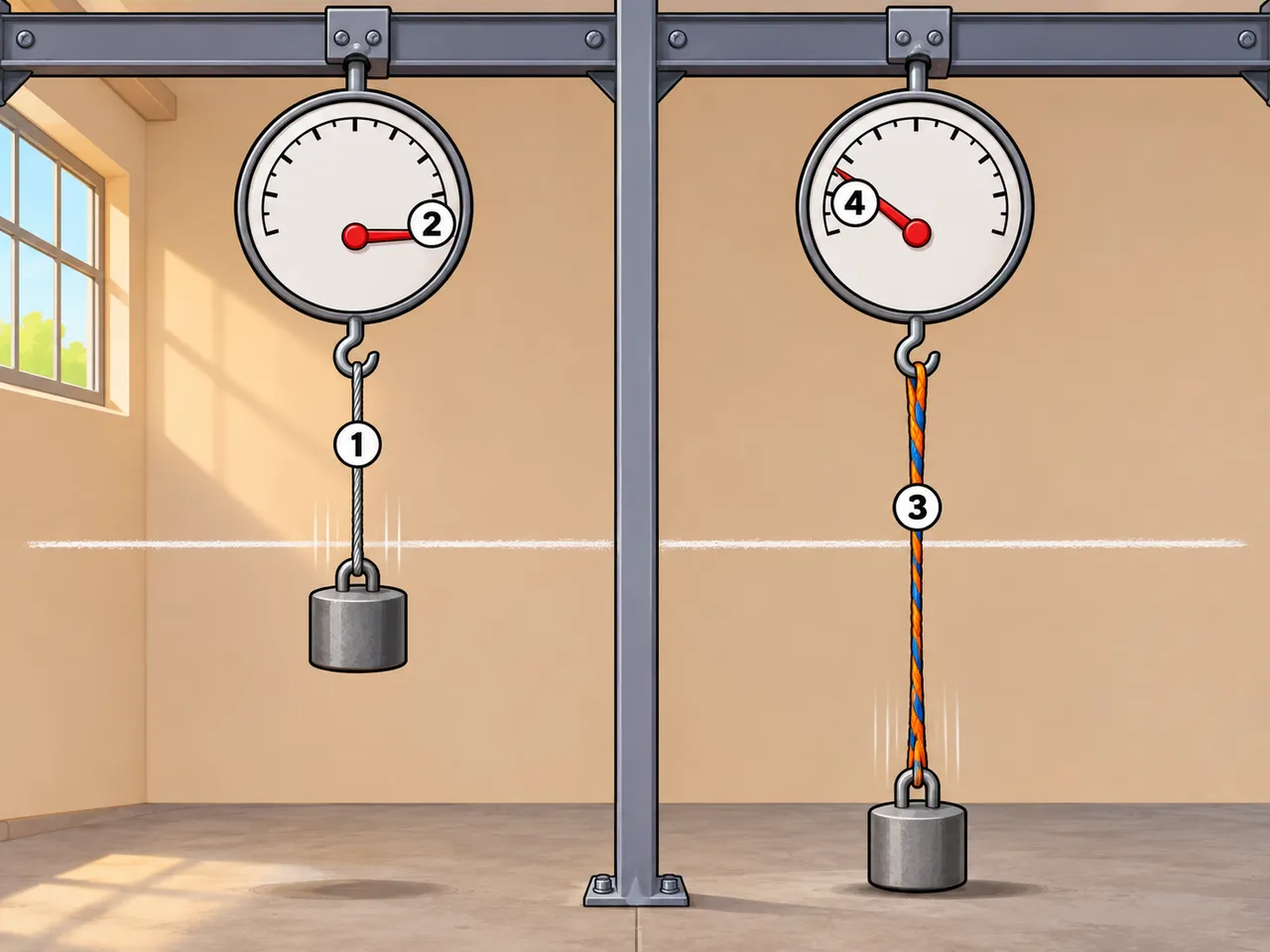
A falling body has to lose all its motion energy before it stops, and the rope does that by pulling over a certain distance. If the rope stretches, the stop takes a longer distance, so the pull needed at any moment is much smaller.
In the picture
- Steel cable: barely stretches, so the weight stops over a very short distance
- Left scale: the needle jumps to its maximum, a very high peak force
- Elastic rope: stretches a lot, so the weight stops over a long distance
- Right scale: the needle stays low, the same fall with a much smaller peak force
Examples
- A climbing rope stretches when a climber falls, so the catch feels like a firm pull instead of a brutal jolt.
- A car’s crumple zone folds up in a crash, giving the passengers a longer distance to slow down.
Key takeaways
- The same energy must be absorbed: force times stopping distance stays the same, so a longer distance means a smaller force.
- Stopping suddenly is what hurts, not the speed itself.
Quiz: Why a stretchy rope softens a fall (Age 16)
-
A falling body is caught by a rope that stretches a lot instead of one that barely stretches. What happens to the peak force of the stop?
-
Two identical weights fall from the same height. One is caught by a steel cable, the other by an elastic rope. Why does the steel cable produce a very high peak force?
-
According to this idea, what actually makes the end of a fall dangerous for a body?
The answers, each with its explanation, are in the app. This quiz is free there while the lesson is in the free week.
Get the app
Free app, optional subscription
App Store Google Play
Carry on in the app
At least one new illustrated lesson every weekday for your child’s year, with its quiz and a reminder at 6:15 pm.
Your child’s teacher does not use My Enhanced Teacher yet?
Tell them about it