Mon Prof Augmenté
The derivative at a point
Age 16 · Maths
Open to everyone until Wednesday, November 25
To keep it, print it while it is open.
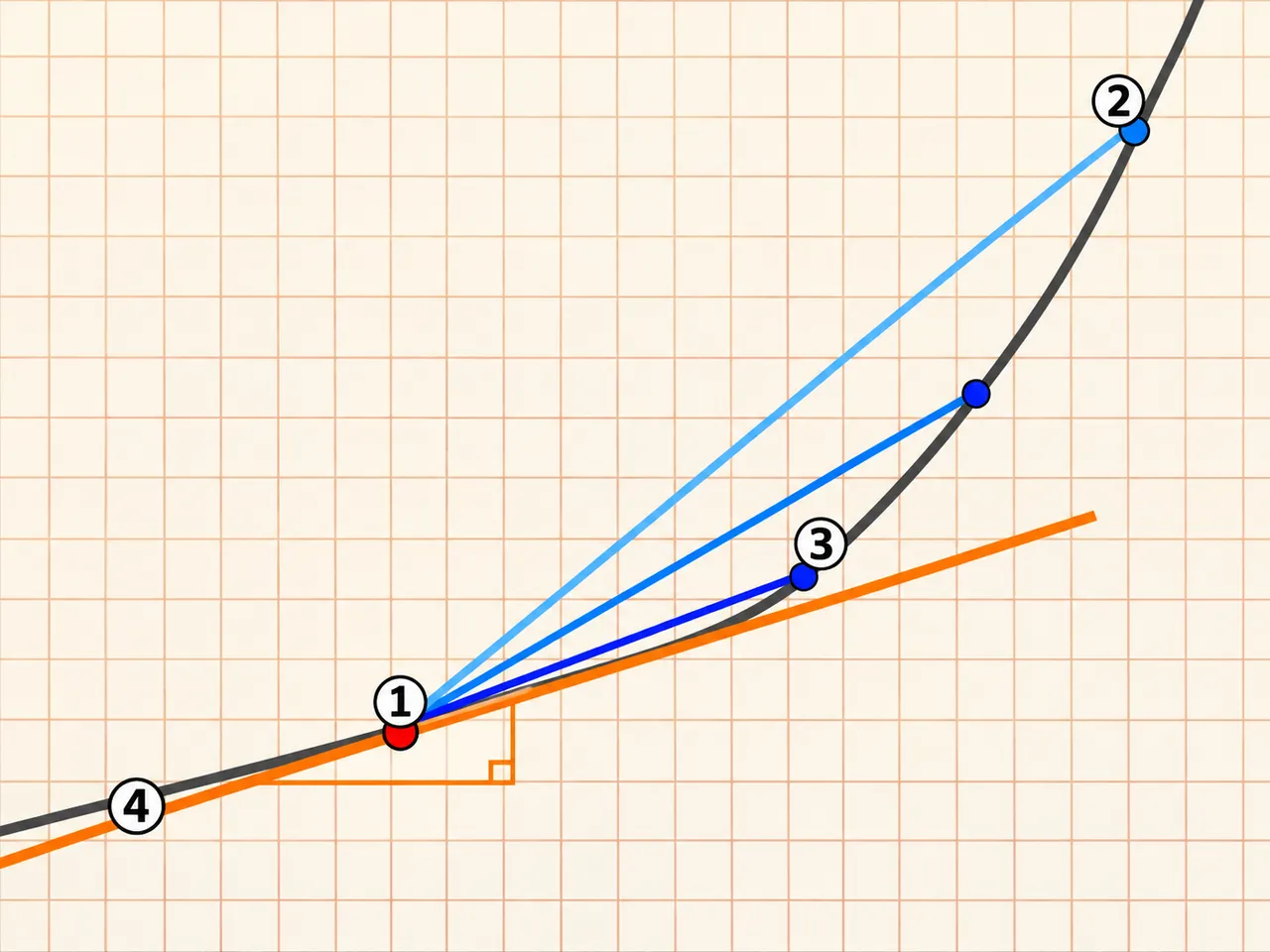
To find how steep a curve is at one exact point, draw lines through that point and a second point, then slide the second point closer and closer. The slopes of these lines approach a single value, the slope of the tangent, which is called the derivative at that point.
In the picture
- The fixed point on the curve: where we want to know the steepness
- A secant line through a far second point: its slope is an average rate of change
- A secant line through a very close second point: its slope is almost the right value
- The tangent line: its slope is the limit of the secant slopes, the derivative
Examples
- A car’s speedometer shows speed at one instant, which is the derivative of the distance travelled with respect to time.
- On a hiking trail profile, the steepness under your feet at one spot is the slope of the tangent there, not the average over the whole climb.
Key takeaways
- The derivative f'(a) is the limit of (f(a+h) − f(a)) / h as h goes to 0.
- A secant gives an average rate of change; the tangent gives the instantaneous rate of change.
Quiz: The derivative at a point (Age 16)
-
A line is drawn through a fixed point on a curve and a second point far away on the same curve. What does the slope of this line tell you?
-
As the second point slides closer and closer to the fixed point, what happens to the slopes of the secant lines?
-
Which expression gives the derivative f'(a)?
The answers, each with its explanation, are in the app. This quiz is free there while the lesson is in the free week.
Get the app
Free app, optional subscription
App Store Google Play
Carry on in the app
At least one new illustrated lesson every weekday for your child’s year, with its quiz and a reminder at 6:15 pm.
Your child’s teacher does not use My Enhanced Teacher yet?
Tell them about it