Mon Prof Augmenté
Titrating until the colour holds
Age 16 · Chemistry
Open to everyone until Monday, November 23
To keep it, print it while it is open.
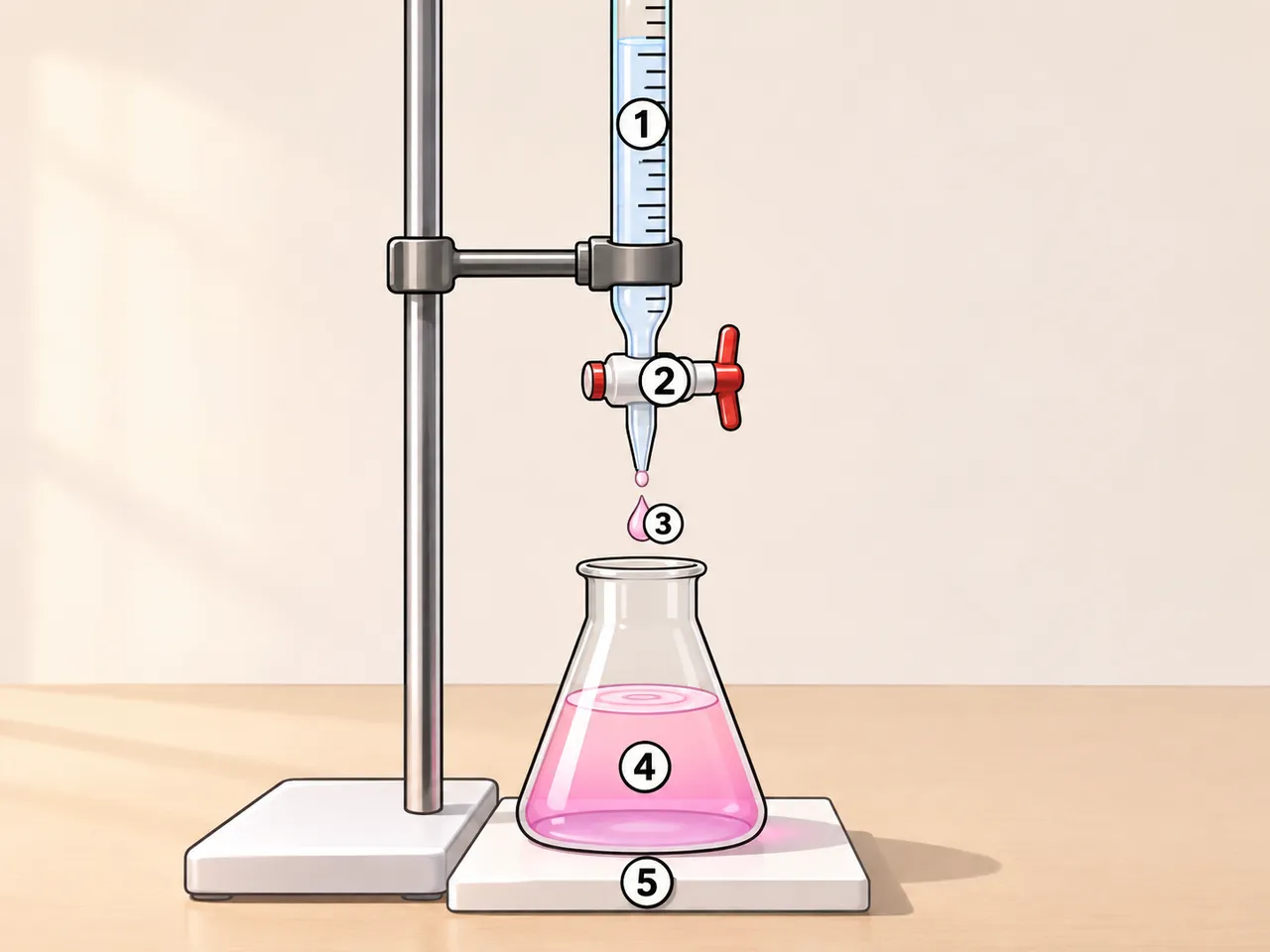
In a redox titration, a solution of known concentration is added drop by drop from a burette to a flask until a colour change appears. The first colour that lasts after swirling marks the equivalence point, where the reactants have exactly balanced.
In the picture
- Burette: holds the titrant and its graduations give the volume added
- Tap: controls how fast the titrant flows, down to single drops
- Drop of titrant: each one reacts with the solution below
- Flask liquid: a faint lasting pink shows the endpoint has been reached
- White tile: makes a faint colour change easier to see
Examples
- Measuring the iron content in a tablet using potassium permanganate, which turns pink at the end
- Checking the vitamin C in fruit juice with an iodine solution that changes colour at the endpoint
Key takeaways
- The endpoint is the first colour change that persists after swirling.
- Adding the last drops slowly gives a precise volume reading.
Quiz: Titrating until the colour holds (Age 16)
-
In a redox titration, what marks the endpoint?
-
Why are the last drops of titrant added slowly?
-
What is true at the equivalence point?
The answers, each with its explanation, are in the app. This quiz is free there while the lesson is in the free week.
Get the app
Free app, optional subscription
App Store Google Play
Carry on in the app
At least one new illustrated lesson every weekday for your child’s year, with its quiz and a reminder at 6:15 pm.
Your child’s teacher does not use My Enhanced Teacher yet?
Tell them about it