Mon Prof Augmenté
A Prism Splits White Light
Age 15 · Science
Open to everyone until Friday, October 30
To keep it, print it while it is open.
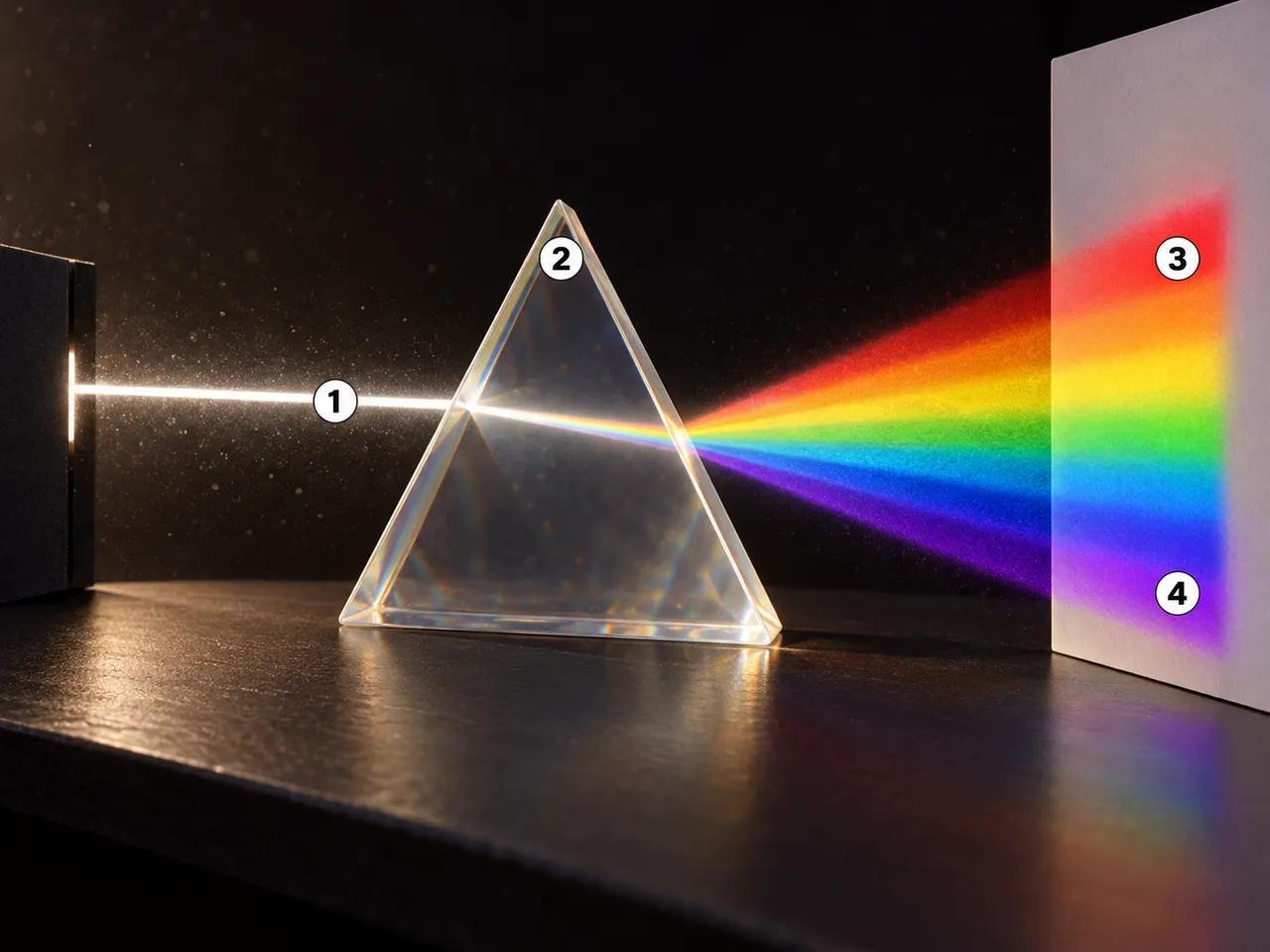
White light is a mix of all colours, and glass bends each colour by a slightly different amount because its refractive index depends on colour. Violet bends the most and red the least, so a prism spreads white light into a rainbow band called a spectrum.
In the picture
- Incoming white light: a mix of every colour travelling together
- Glass prism: bends the light at both faces, each colour by a different amount
- Red light: smallest refractive index, bent the least
- Violet light: largest refractive index, bent the most
Examples
- A rainbow forms when raindrops split sunlight into colours like tiny prisms
- The cut faces of a diamond or a glass chandelier throw small rainbows onto the walls
Key takeaways
- The refractive index of glass is slightly higher for violet light than for red light
- The colours of the spectrum, from least to most bent, are red, orange, yellow, green, blue, indigo, violet
Quiz: A Prism Splits White Light (Age 15)
-
What is white light made of?
-
Why does a glass prism spread white light into a spectrum?
-
How does violet light compare with red light inside glass?
The answers, each with its explanation, are in the app. This quiz is free there while the lesson is in the free week.
Get the app
Free app, optional subscription
App Store Google Play
Carry on in the app
At least one new illustrated lesson every weekday for your child’s year, with its quiz and a reminder at 6:15 pm.
Your child’s teacher does not use My Enhanced Teacher yet?
Tell them about it