Mon Prof Augmenté
Arrows End to End
Age 15 · Maths

Two arrows can be joined by placing the second arrow’s tail at the first arrow’s tip. The arrow from the first tail to the final tip shows the combined displacement.
This picture is part of the full library
Every lesson is open to everyone for 7 days after it is published. This one came out on October 15, 2026: its text stays readable here, and its picture opens with a subscription.
The app is free. A subscription opens every lesson, in every school year.
Age 15: open this week
Browse Age 15
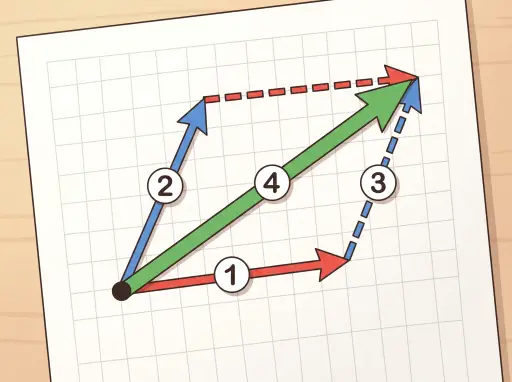
In the picture
- The starting point where the first arrow begins.
- The first arrow, running from the starting point to its tip.
- The second arrow, whose tail sits at the first arrow’s tip.
- The straight arrow from the first starting point to the second arrow’s tip.
Examples
- Walking 3 blocks east, then 4 blocks north: the straight path from start to finish is the combined displacement.
- A boat rowed across a river while the current pushes it downstream: its actual path from start to shore is the combination of both motions.
Key takeaways
- Joining arrows tip to tail gives a new arrow from the first tail to the last tip.
- The order of joining does not change the final arrow.
Quiz: Arrows End to End (Age 15)
-
When two arrows are joined tip to tail, where does the new arrow run?
-
The second arrow’s tail is placed at the first arrow’s tip. What does the straight arrow from the first starting point to the second arrow’s tip show?
-
If the same two arrows are joined in the opposite order, what is the final arrow?
The answers, each with its explanation, are in the app. This lesson has left the free week, so its quiz is part of the subscription.
Free app, optional subscription
App Store Google Play
Carry on in the app
At least one new illustrated lesson every weekday for your child’s year, with its quiz and a reminder at 6:15 pm.
Your child’s teacher does not use My Enhanced Teacher yet?
Tell them about it