Mon Prof Augmenté
Electron shells in atoms
Age 15 · Chemistry
Open to everyone until Tuesday, October 27
To keep it, print it while it is open.
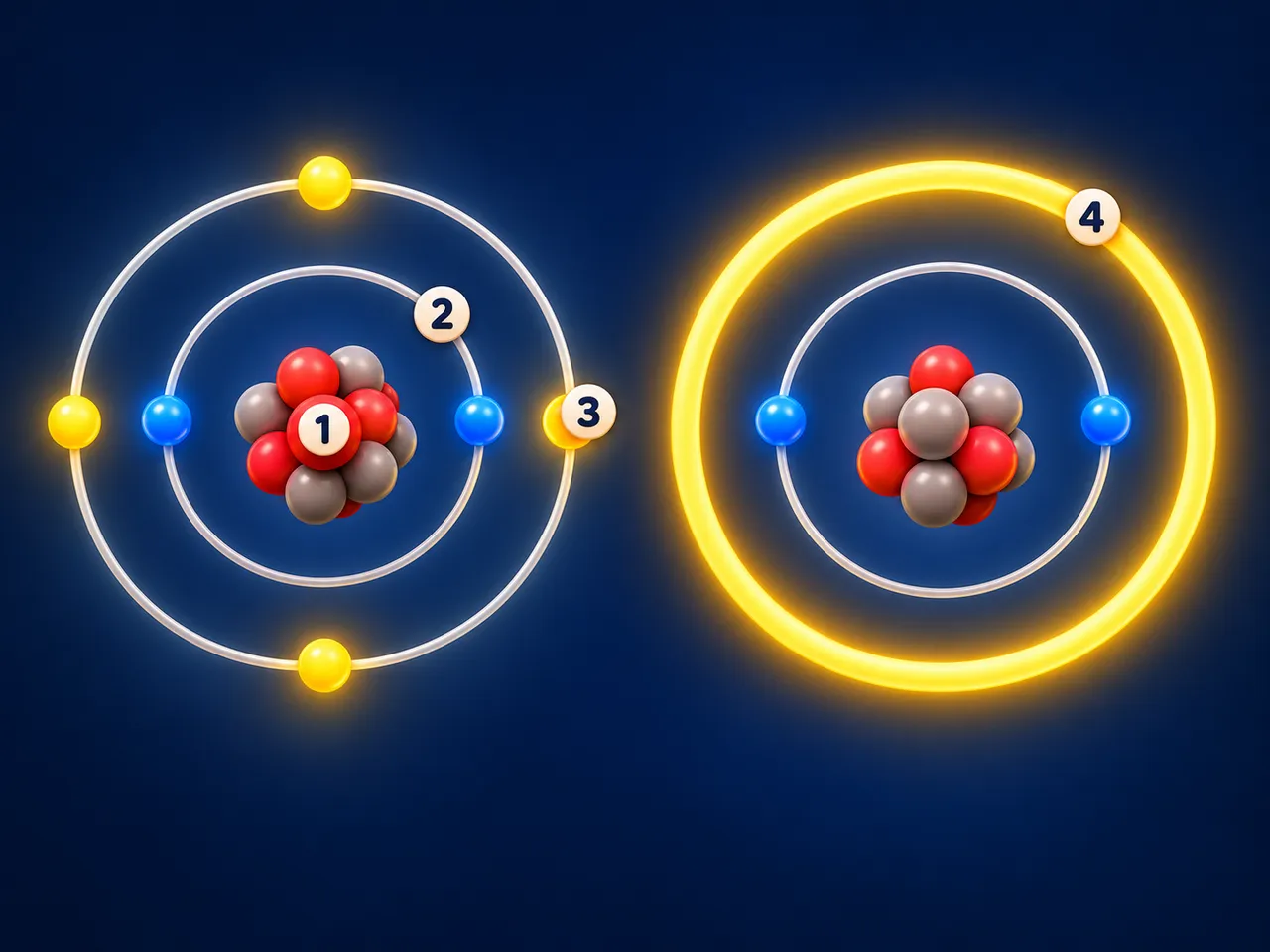
Atoms have a central nucleus made of protons and neutrons, with electrons arranged in shells around it. The outermost shell holds valence electrons, and a full outer shell makes noble gases stable.
In the picture
- Central cluster of red and grey spheres: protons and neutrons packed in the nucleus
- Inner pale ring with two blue dots: the first electron shell
- Outer pale ring with four yellow dots: valence electrons in the outer shell
- Continuous glowing yellow band around the second model: a full outer electron shell
Examples
- Helium in a balloon is unreactive because its outer shell is full.
- Sodium reacts quickly with water because it has one valence electron in its outer shell.
Key takeaways
- Electrons occupy shells around the nucleus, not random positions.
- Atoms with full outer shells, like noble gases, are chemically stable and unreactive.
Quiz: Electron shells in atoms (Age 15)
-
Which statement correctly describes electrons in an atom?
-
What does the central nucleus of an atom contain?
-
Why are noble gases chemically stable and unreactive?
The answers, each with its explanation, are in the app. This quiz is free there while the lesson is in the free week.
Get the app
Free app, optional subscription
App Store Google Play
Carry on in the app
At least one new illustrated lesson every weekday for your child’s year, with its quiz and a reminder at 6:15 pm.
Your child’s teacher does not use My Enhanced Teacher yet?
Tell them about it