Mon Prof Augmenté
Sail, keel, and forward motion
Open to everyone until Friday, October 2
To keep it, print it while it is open.
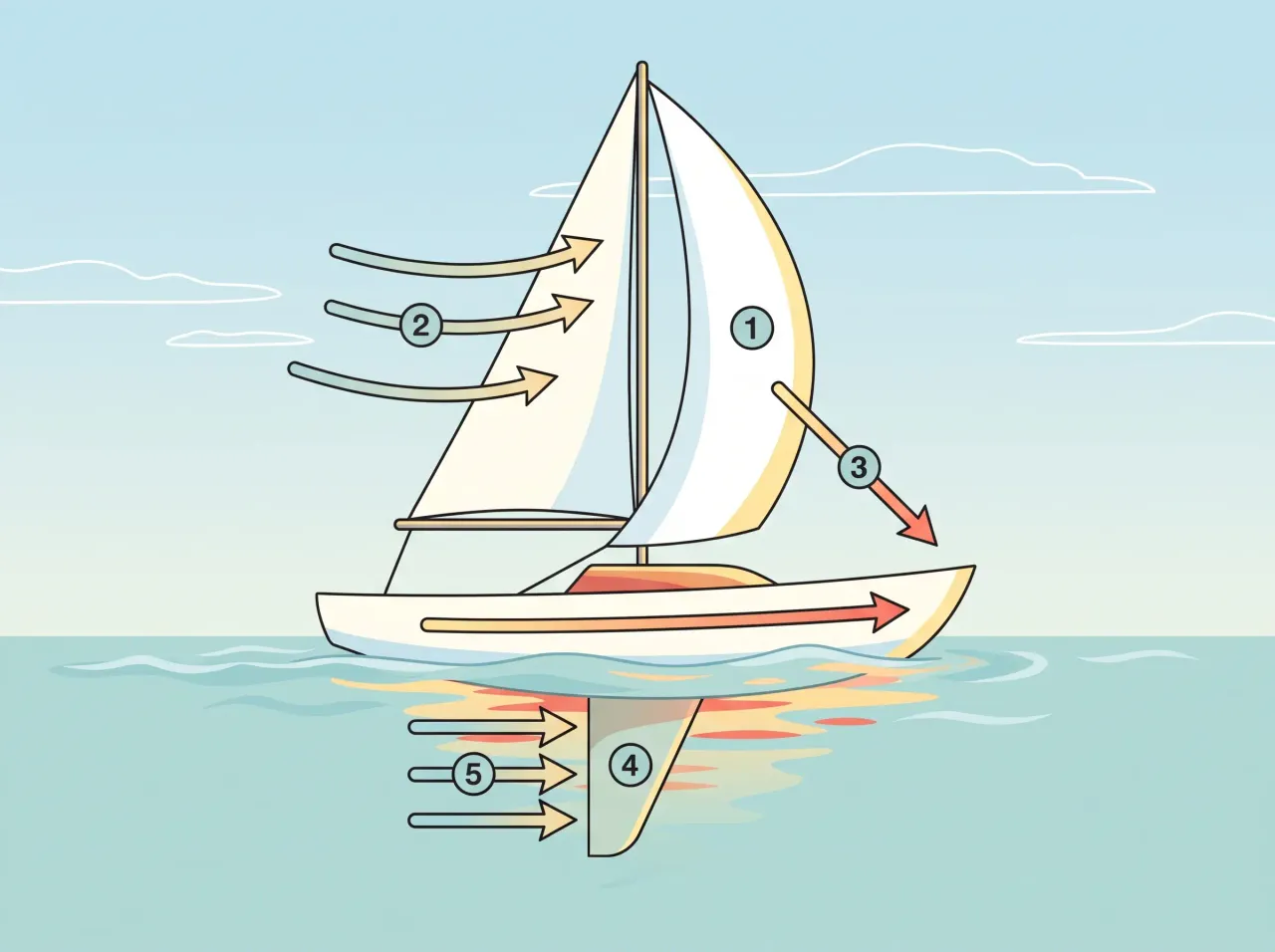
Wind moving past the curved sail creates a force that points at an angle from the sail. The keel in the water blocks sideways drift, so the boat moves forward along its length.
In the picture
- The curved sail: it turns the moving air.
- The wind arrows: moving air arriving at the sail.
- The long arrow from the sail: the force that points away from the sail’s surface.
- The keel fin: a blade under the hull that enters the water.
- The water arrows along the keel: water pushing back against sideways motion.
Examples
- A shopping cart’s fixed wheels stop it sliding sideways but let it roll forward.
- A paper airplane with a folded fin flies straighter than a flat sheet.
Key takeaways
- Wind on the sail gives a force, and the keel’s water resistance cancels the sideways part.
- Boats use air and water together to turn wind into forward motion.
Carry on in the app
Three questions on this lesson, to check the idea stuck. Free in the app while the lesson is in the free week.
At least one new illustrated lesson every weekday for your child’s year, with its quiz and a reminder at 6:15 pm.
Get the app
Free app, optional subscription
App Store Google Play