Mon Prof Augmenté
Light takes time to travel
Age 13 · Physics
Open to everyone until Monday, November 23
To keep it, print it while it is open.
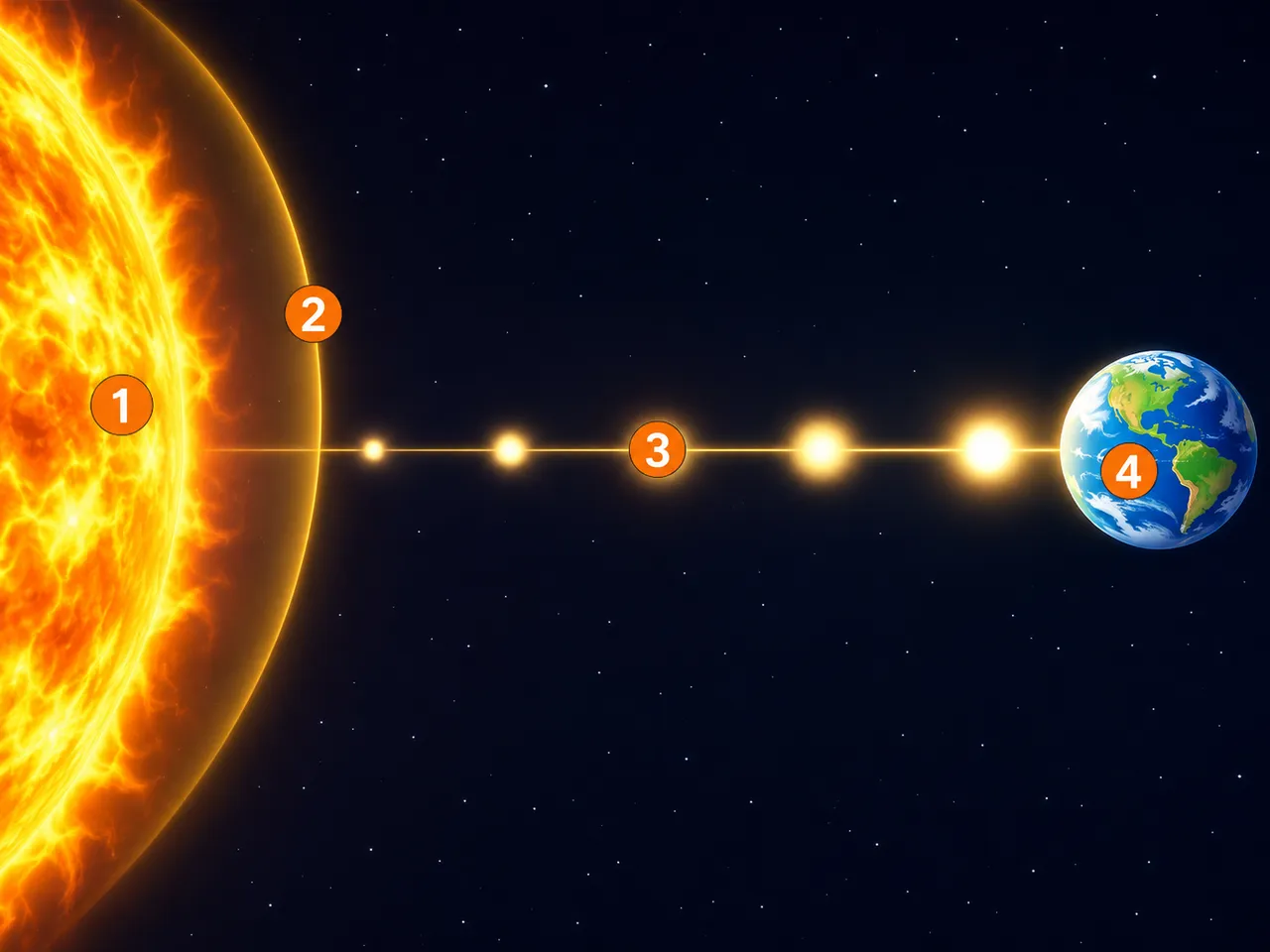
Light moves extremely fast, about 300,000 km every second, but not instantly. So crossing any distance takes time, and you find it with duration = distance ÷ speed.
In the picture
- The Sun: the source that sends out light
- The wavefront: light spreading outward from the source
- A light pulse: light moving along its path at a fixed speed
- The Earth: where the light arrives after a delay
Examples
- Sunlight is about 150 million km away, so it needs roughly 8 minutes 20 seconds to reach Earth.
- Moonlight left the Moon about 1.3 seconds before you see it, because the Moon is about 384,000 km away.
Key takeaways
- Light travels at about 300,000 km/s in vacuum.
- Travel time = distance ÷ speed, so farther means a longer wait.
Quiz: Light takes time to travel (Age 13)
-
When light travels from a source to a place far away, what happens?
-
About how fast does light travel in vacuum?
-
A light source is moved twice as far away. What happens to the time its light takes to arrive?
The answers, each with its explanation, are in the app. This quiz is free there while the lesson is in the free week.
Get the app
Free app, optional subscription
App Store Google Play
Carry on in the app
At least one new illustrated lesson every weekday for your child’s year, with its quiz and a reminder at 6:15 pm.
Your child’s teacher does not use My Enhanced Teacher yet?
Tell them about it