Mon Prof Augmenté
Gears that trade speed for force
Age 13 · Technology
Open to everyone until Wednesday, November 25
To keep it, print it while it is open.
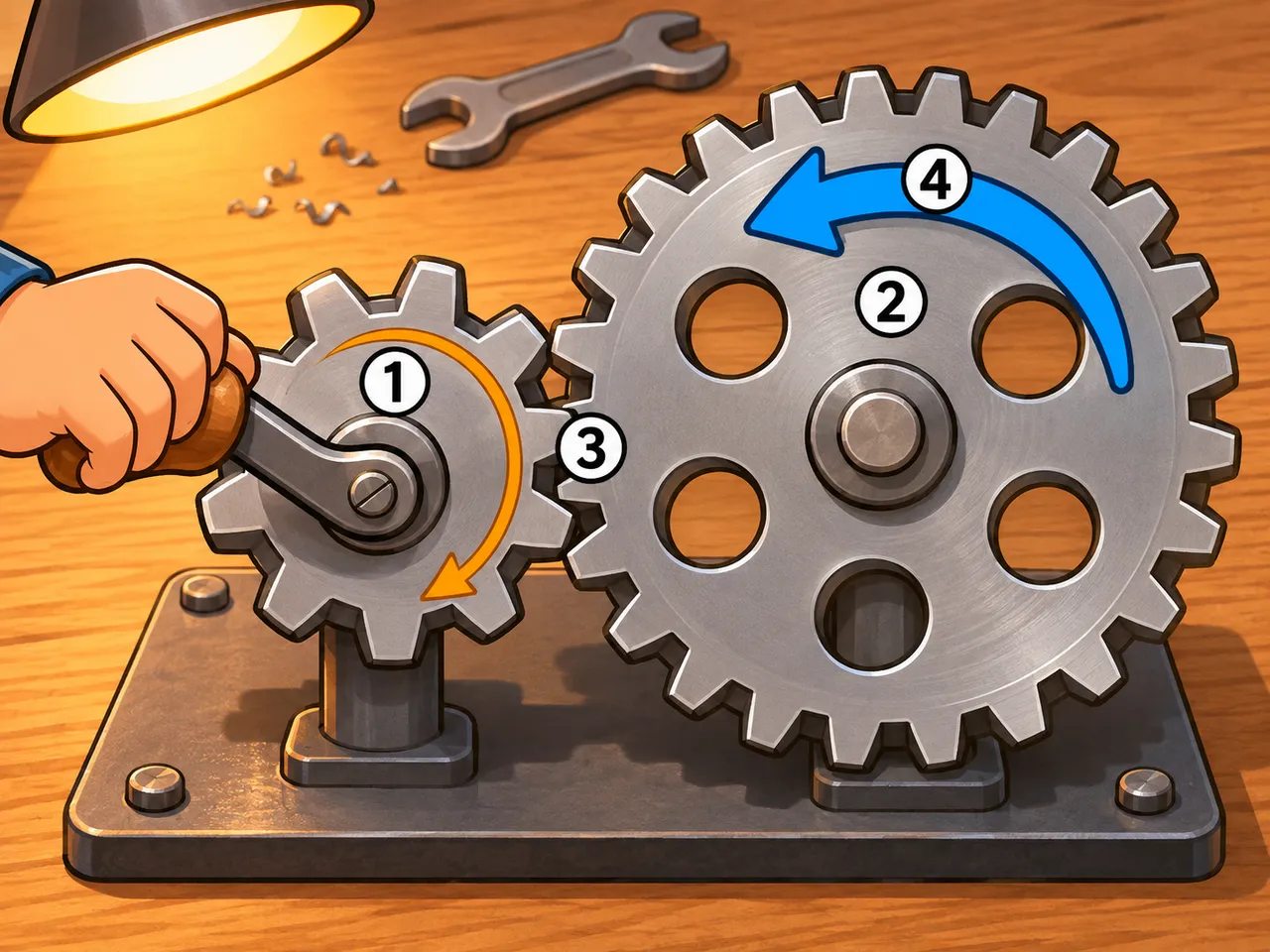
When a small gear drives a larger one, the large gear turns more slowly but with more turning force. A gear train is a way to swap speed for strength.
In the picture
- Small driving gear: turned by the crank, it spins fast with little force
- Large driven gear: more teeth, so it turns more slowly
- Meshing teeth: each tooth pushes the next, so the two gears turn in opposite directions
- Short thick arrow: less speed, but more turning force
Examples
- On a bike, choosing a low gear for a hill makes pedalling easier, but the wheel turns more slowly.
- A hand whisk works the other way round: a large gear drives small ones, so the beaters spin very fast.
Key takeaways
- Small gear driving a large gear: less speed, more turning force.
- Two meshed gears always turn in opposite directions.
Quiz: Gears that trade speed for force (Age 13)
-
A small gear drives a larger gear. How does the larger gear turn compared with the small one?
-
Two gears are meshed together. What can you say about the directions they turn in?
-
Why does the large driven gear turn more slowly than the small gear that drives it?
The answers, each with its explanation, are in the app. This quiz is free there while the lesson is in the free week.
Get the app
Free app, optional subscription
App Store Google Play
Carry on in the app
At least one new illustrated lesson every weekday for your child’s year, with its quiz and a reminder at 6:15 pm.
Your child’s teacher does not use My Enhanced Teacher yet?
Tell them about it