Mon Prof Augmenté
A Star Becomes a Black Hole
A very massive star can run out of fuel and collapse. Its outer layers blast away, and the core can shrink into a tiny, extremely dense black hole.
This picture is part of the full library
Every lesson is open to everyone for 7 days after it is published. This one came out on September 17, 2026: its text stays readable here, and its picture opens with a subscription.
The app is free. A subscription opens every lesson, in every school year.
Age 13: open this week
Browse Age 13

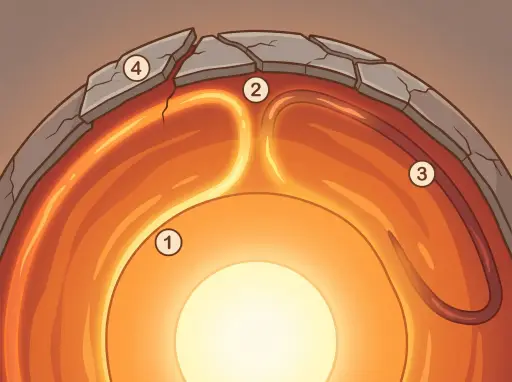
In the picture
- The massive star: a huge, hot ball of glowing gas.
- The collapsing core: a small dense center sinking inward.
- The expanding cloud: hot gas thrown outward from the star.
- The tiny bright point: an extremely small, dense remnant left by the core.
- The dimple around the point: a deep dip in the background.
Examples
- A bowling ball on a trampoline makes a dip in the fabric, like the dimple around a black hole.
- A snowball squeezed in your hand gets smaller and denser.
Key takeaways
- A massive star can leave behind a stellar black hole after a supernova.
- A stellar black hole is extremely small and dense, and it warps space around it.
Carry on in the app
Three questions on this lesson. It has left the free week, so its quiz is for subscribers.
At least one new illustrated lesson every weekday for your child’s year, with its quiz and a reminder at 6:15 pm.
Get the app
Free app, optional subscription
App Store Google Play