Mon Prof Augmenté
Water on a Round Trip
Age 10 · Science
Open to everyone until Monday, November 16
To keep it, print it while it is open.
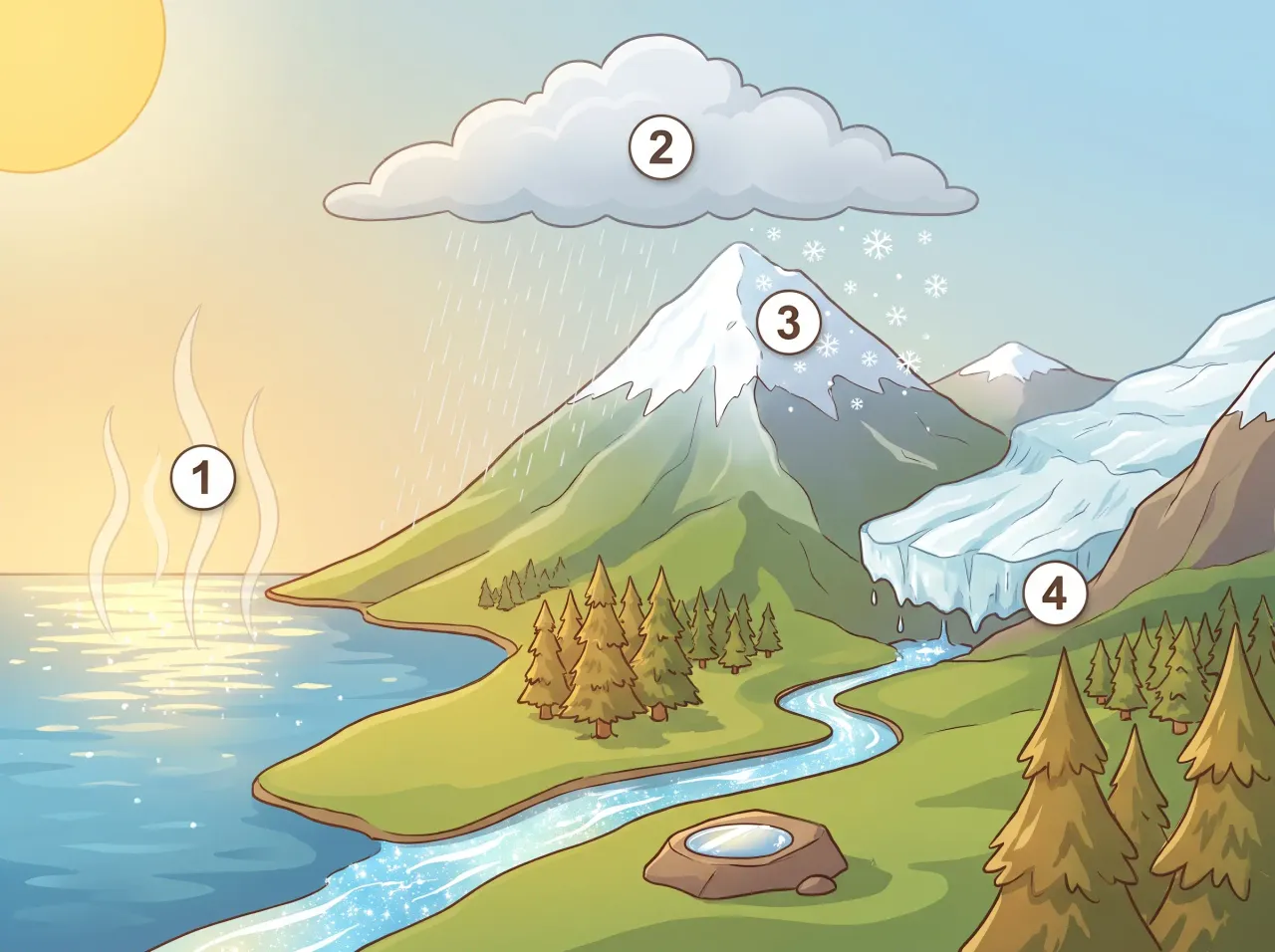
Water can be a solid (ice), a liquid (water) or a gas (water vapour), and it changes from one to another when it warms up or cools down. In nature, these changes keep water moving in a big loop between the sea, the sky and the mountains.
In the picture
- Sea warmed by the sun: liquid water evaporates into water vapour, a gas
- Cloud above the mountain: water vapour cools and condenses into tiny droplets
- Snowy summit: in the cold, water freezes into solid snow and ice
- Melting glacier: ice melts into liquid water that flows back to the sea
Examples
- An ice cube left on a plate melts into a puddle, and water in the freezer turns back into ice.
- Drops form on a cold glass of juice when water vapour from the air condenses on it.
Key takeaways
- Heating makes ice melt and water evaporate; cooling makes vapour condense and water freeze.
- These changes are reversible: the same water can go back and forth between solid, liquid and gas.
Quiz: Water on a Round Trip (Age 10)
-
What happens to water vapour when it cools down high in the sky?
-
What happens to ice when it warms up?
-
Water from a melting glacier flows back to the sea. Can that same water become a gas again?
The answers, each with its explanation, are in the app. This quiz is free there while the lesson is in the free week.
Get the app
Free app, optional subscription
App Store Google Play
Carry on in the app
At least one new illustrated lesson every weekday for your child’s year, with its quiz and a reminder at 6:15 pm.
Your child’s teacher does not use My Enhanced Teacher yet?
Tell them about it